

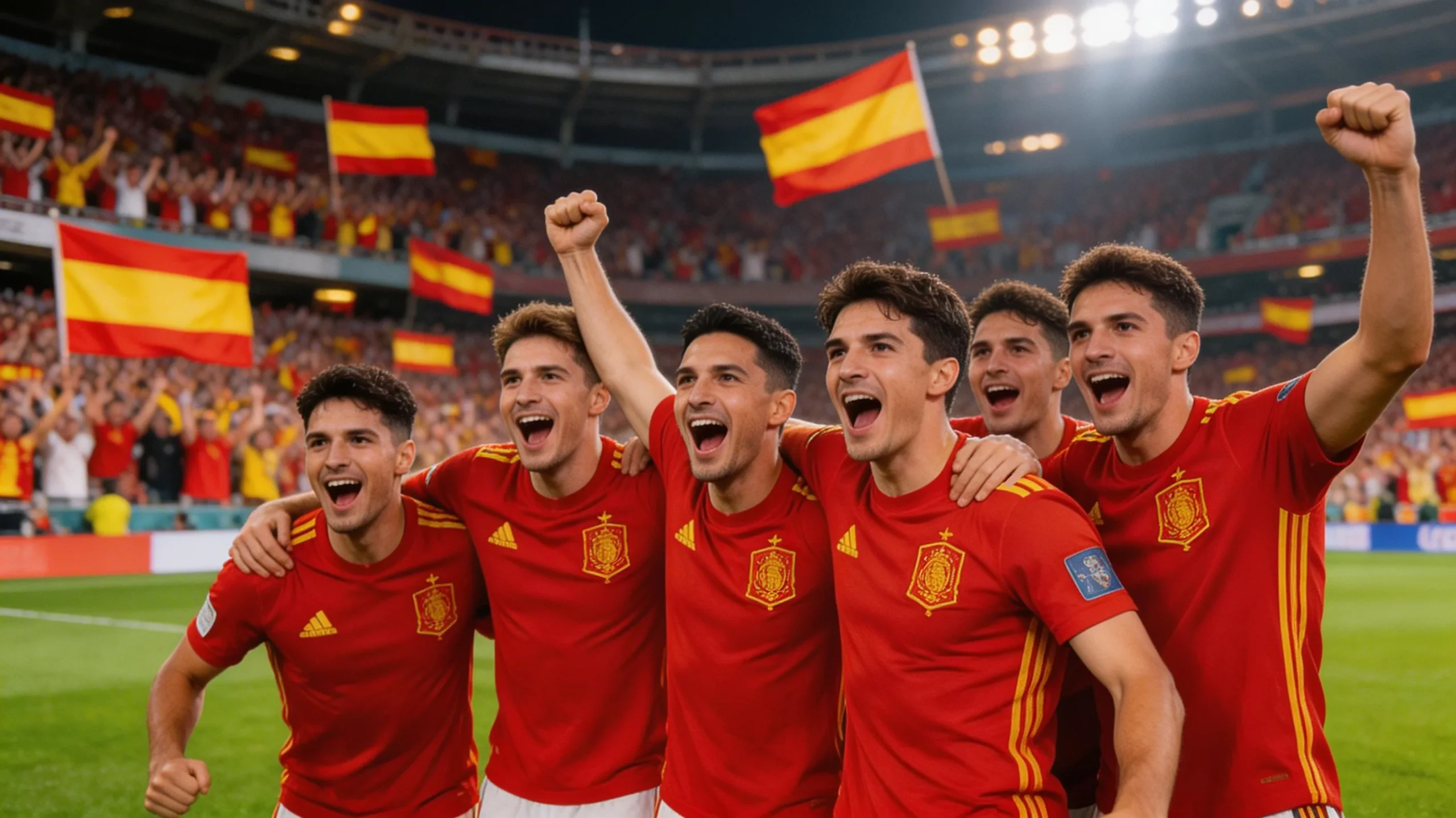
Spain arrived at Euro 2024 amid skepticism. The tiki-taka dominance of 2008-2012 had faded, replaced by transitional squads that reached tournament stages without recapturing peak excellence. Then Lamine Yamal happened. A 16-year-old playing with the audacity of a veteran, combined with Nico Williams’ pace on the opposite flank, transformed Spanish football’s perception overnight. The Euro 2024 triumph wasn’t just a trophy – it announced that Spain’s next golden generation had arrived ahead of schedule.
The World Cup 2026 timing couldn’t favor Spain more perfectly. Yamal turns 18 just before the tournament begins, still young enough to possess that fearless creativity while having accumulated two years of additional development since his Euro 2024 explosion. The supporting cast around him has solidified. The system under Luis de la Fuente has proven itself under tournament pressure. Spain enters 2026 as legitimate co-favorites with a ceiling as high as any nation in the field.
Euro 2024 Champions Momentum
The Euro 2024 campaign established Spanish football’s renewed identity. Seven matches, seven victories, a dominant run that recalled their peak years without simply repeating past approaches. The blend of possession control with direct attacking – through Yamal and Williams’ wing play – created an evolution that opponents couldn’t contain.
The final against England showcased what this Spain does best. Absorbing early English pressure, then devastating them through counter-attacks and wing combinations that Cole Palmer’s early goal couldn’t prevent. The 2-1 victory secured Spain’s record fourth European Championship while announcing their 2026 World Cup credentials.
The tournament progression demonstrated depth that previous Spanish transitional squads lacked. Rodri’s midfield dominance, Dani Olmo’s creative contributions from the bench, Fabian Ruiz’s control when deployed – options existed throughout the squad that kept Spain dangerous regardless of opponent adjustments. This depth translates directly to World Cup demands where seven matches across four weeks test squad management.
The momentum question involves sustaining championship-level performance across the two years between Euro 2024 and World Cup 2026. Some nations struggle to maintain intensity after major triumphs – celebration affecting hunger. Spain’s young core suggests the opposite dynamic: Yamal and Williams want more, their Euro 2024 success whetting appetite rather than satisfying ambition. This psychological profile favors sustained motivation.
The qualifying period between tournaments provided opportunity for system consolidation rather than radical change. De la Fuente maintained the approach that produced European success while integrating additional options and managing workloads. Spain enters 2026 with established identity that tournament preparation refines rather than creates from scratch.
Lamine Yamal – Teenage Sensation
Comparing Lamine Yamal to previous prodigies understates what he’s already accomplished. At 16 during Euro 2024, he produced performances that seasoned internationals couldn’t match – the semifinal goal against France, the consistent threat throughout seven matches, the composure that suggested he’d already lived through tournaments he was experiencing for the first time.
His development since that breakthrough has only confirmed the initial impression. Barcelona’s increasing reliance on his creativity reflects recognition that Yamal isn’t a prospect anymore – he’s a current star whose ceiling remains unknown. The statistical profile at 17 matches what elite wingers achieve in their mid-twenties, suggesting either an unprecedented early peak or sustained excellence for the next decade.
For World Cup 2026, Yamal enters at 18 with the perfect combination: the fearlessness of youth combined with major tournament experience. He’s played decisive matches under maximum pressure and delivered. That psychological foundation doesn’t exist for most 18-year-olds, but Yamal has already proven he possesses it.
The individual markets around Yamal deserve attention despite his youth. Golden Boot odds of approximately +1200 reflect his attacking role and Spain’s expected deep run. Young Player Award positioning at shorter odds captures what seems like inevitable recognition for the tournament’s most talented teenager. These positions leverage Yamal’s unique profile without requiring outcomes that even his talent can’t guarantee.
The injury concerns that apply to young players subjected to heavy workloads apply to Yamal. Barcelona’s management of his minutes has been careful but imperfect. Whether his body handles World Cup demands without breaking down creates uncertainty that his talent alone can’t address. If Yamal stays healthy throughout, Spanish ceiling reaches tournament victory. If injury intervenes, their attacking patterns lose their most dangerous element.
The partnership with Nico Williams deserves equal attention. The two wingers create symmetrical threats that defenders can’t simply shade toward one side. Williams’ pace and directness from the left matches Yamal’s creativity from the right, forcing opponents into impossible choices about where to allocate defensive attention. When both players function at full capacity, Spanish attacking patterns become nearly undefendable – a dynamic that Euro 2024 opponents discovered painfully.
Squad Depth
Beyond Yamal, Spanish squad composition reflects quality at every position that challenges any nation for depth. The Euro 2024 winners provide a proven core while emerging options add alternatives that keep Spain dangerous regardless of specific personnel.
Goalkeeping features Unai Simón as the established choice, his Athletic Bilbao career demonstrating quality that international competition has confirmed. The distribution that Spain’s possession game requires comes naturally, while shot-stopping has improved from earlier career questions. The backup options provide adequate coverage without matching Simón’s level.
The defensive structure centers on proven performers. Dani Carvajal’s experience and quality from right-back, Marc Cucurella’s emergence at left-back, Aymeric Laporte and Robin Le Normand’s central partnership – these players have demonstrated tournament capability through Euro 2024 performances. The depth behind them includes options who function within the system adequately.
Central midfield showcases perhaps football’s best current player. Rodri’s Ballon d’Or recognition confirmed what matches demonstrated – he controls games through positioning, passing, and defensive contribution that exceeds any contemporary comparison. Around Rodri, Pedri’s creative excellence and Fabian Ruiz’s technical quality create a midfield trio that dominates possession against anyone.
The attacking options extend beyond Yamal and Williams. Alvaro Morata’s experience provides different qualities when needed. Ferran Torres’ finishing offers alternative approach. Dani Olmo’s creative contributions from central positions add versatility that pure wing play doesn’t provide. The bench introduces players who would start for most national teams.
The age profile optimizes for both 2026 and beyond. Yamal at 18, Pedri at 23, Williams at 23 – the attacking core enters physical prime with developmental ceiling remaining. The experienced performers – Rodri at 30, Carvajal at 34, Morata at 33 – provide tournament nous without dominating squad composition. This balance creates immediate championship capability while ensuring sustained competitiveness for future tournaments.
The system flexibility under de la Fuente adds tactical dimension. Spain can dominate possession against teams who allow it, or play direct through Yamal and Williams against opponents who press aggressively. This dual approach confused Euro 2024 opponents who prepared for one Spanish style and faced another. World Cup opponents face similar challenges identifying which Spain they’ll encounter.
Group H Analysis
Spain’s draw places them in Group H alongside Saudi Arabia, Cape Verde, and Uruguay. This composition presents interesting dynamics – Uruguay specifically creates challenges that Group H betting must respect.
Uruguay arrives as South American tournament specialists, their consistent Copa America performances demonstrating quality that their FIFA ranking reflects. The experienced core – veterans combined with emerging talents – creates a team that doesn’t fear European powers. The Spain-Uruguay match represents Group H’s most competitive fixture, with potential to surprise Spanish dominance assumptions.
Saudi Arabia returns after their 2022 World Cup upset of Argentina demonstrated their ceiling moments. The team that shocked tournament favorites possesses capability that can’t be dismissed, even if consistent performance at that level remains uncertain. Against Spain, Saudi defensive organization will attempt to frustrate before creating counter-attacking chances.
Cape Verde makes their World Cup debut representing African qualification’s expanded opportunities. Their path to 2026 required overcoming established African powers, suggesting quality that debutant status might obscure. Against Spain, expect Cape Verdean organization designed to compete rather than simply survive – the occasion of World Cup debut provides motivation that experienced nations can’t match.
Group H betting: Spain -200 to top the group appropriately reflects their quality while acknowledging Uruguay’s capabilities. Advancement at -500 offers no value for near-certain qualification. Match-specific opportunities involve Spain-Uruguay total goals and margin betting, while Spain’s margins against Saudi Arabia and Cape Verde present clearer value propositions.
The venue assignments within Group H affect Spanish preparation. Playing across different US cities requires adaptation that European clubs don’t demand. The summer heat in potential venues tests squad fitness differently than European summer conditions. How Spain manages these environmental factors – hydration, training intensity, recovery protocols – influences performance across group matches and into knockout rounds.
The Uruguay fixture’s specific timing matters for betting purposes. If that match determines group winner with knockout bracket implications, both teams approach intensely. If earlier results clarify positioning, tactical considerations change. Monitoring group stage progression before committing to Spain-Uruguay positions allows better assessment of actual match stakes.
Spain World Cup Odds
The outright market prices Spain between +500 and +700, positioning them among the three or four genuine favorites. The implied probability of 12-16% reflects their Euro 2024 triumph, squad quality, and Yamal’s presence as tournament football’s most exciting player.
I find Spanish odds slightly generous given their current form and trajectory. Their ceiling matches any nation – the Euro 2024 performance demonstrated what they achieve when everything aligns. Their floor remains high because the tactical system and personnel quality prevent collapse. The price captures reasonable probability while potentially undervaluing their championship likelihood.
The value positions involve Spanish progression and individual markets. Spain to reach the final at approximately +160 offers genuine value given their expected path and quality level. Spain to win their semifinal if they reach it prices around -120 to even money depending on opponent – situational positions that capture Spanish quality against specific matchups.
Yamal and Rodri markets mentioned earlier deserve emphasis as Spanish best betting angles. Rodri for tournament MVP at prices reflecting his Ballon d’Or status offers value if Spain advances deep. These individual positions leverage Spanish strengths without requiring championship victory that tournament variance can deny.
Betting on La Roja
Spanish betting patterns suit their dominant possession style. The opportunities exist in positions that leverage their control while acknowledging that dominance doesn’t guarantee victory.
Spanish possession metrics exceed tournament averages significantly. Over 55% possession in Spanish matches at reasonable prices captures their stylistic dominance without requiring scoreline predictions. This statistical position compounds across multiple matches for consistent value.
Match totals in Spanish games require nuanced assessment. Their possession dominance can suppress opposition chances while creating their own opportunities – but this doesn’t always produce high-scoring affairs. Under 3.5 goals in competitive Spanish matches at reasonable prices captures the control that limits both teams’ chaos.
Spanish corners reflect their territorial dominance. Sustained possession in attacking areas generates corner opportunities at rates exceeding tournament averages. Spain over team corners offers value that accumulates across group stage matches without requiring scoreline outcomes.
Avoid betting against Spanish first-half leads in group stage matches. Their early possession dominance against weaker opponents typically produces goals before halftime. Spain leading at halftime in matches against Saudi Arabia and Cape Verde at approximately -130 captures expected patterns.
The live betting dynamics in Spanish matches follow predictable patterns. Their possession dominance means trailing scenarios become opportunities for value as opponents tire. If Spain concedes first against competitive opponents, live lines often overreact because their style eventually creates chances. Patience with Spanish live betting positions has historically rewarded bettors who understood their comeback capability.
The defensive markets present less clear value. Spain’s attacking approach sometimes accepts defensive risk that produces goals against even from weaker opponents. Clean sheet bets require assessing specific opponent attacking quality rather than assuming Spanish dominance prevents all chances. Against Uruguay particularly, both teams to score markets capture mutual attacking capability that Spanish control doesn’t eliminate.
Spain World Cup Record
The 2010 World Cup triumph in South Africa remains Spanish football’s greatest achievement. The tiki-taka system, refined through Euro 2008 and 2012 success, reached its peak with that tournament victory. Iniesta’s winning goal against Netherlands in the final secured Spain’s place among football’s elite nations.
The subsequent period produced transition struggles that Euro 2024 finally resolved. The 2014 group-stage exit, disappointing performances in 2018 and 2022 knockout rounds – Spain searched for identity after the golden generation departed. Various managers attempted different approaches without finding sustainable success.
The Euro 2024 breakthrough established what feels like a new era rather than a single tournament success. The young core that delivered European glory enters 2026 as established international performers with development remaining. This trajectory differs from previous Spanish transitions that lacked equivalent talent emergence.
The historical pattern for Spain shows capability for championship victory when system and talent align. The 2010 World Cup and three European Championships demonstrate tournament-winning quality when conditions suit. Current conditions – tactical clarity, emerging stars, proven depth – suggest 2026 presents championship opportunity.
The comparison between current Spain and the 2010 champions reveals interesting parallels. Both squads feature young players who’ve already proven themselves at the highest level, supported by experienced performers who provide stability. Both possess midfield dominance that controls matches – Rodri’s current role echoing what Xavi, Iniesta, and Busquets achieved. These structural similarities suggest similar outcomes are possible.
The difference involves playing style evolution. The 2010 squad defined tiki-taka through relentless possession and patient buildup. The 2026 squad possesses those capabilities while adding direct attacking through Yamal and Williams’ pace. This evolution makes current Spain more dangerous in transitions while maintaining possession dominance – a combination that the 2010 squad didn’t need to develop against that era’s opponents.
My projection for Spain: semifinal appearance with approximately 65% probability, final at 45%, tournament victory at 20%. These numbers slightly exceed implied market probability, reflecting my assessment that Euro 2024 momentum and Yamal’s development create genuine championship favorite status. The value exists throughout Spanish odds structure – from comparing World Cup teams, Spain represents the kind of current-form favorite whose prices haven’t fully adjusted to their trajectory.
