

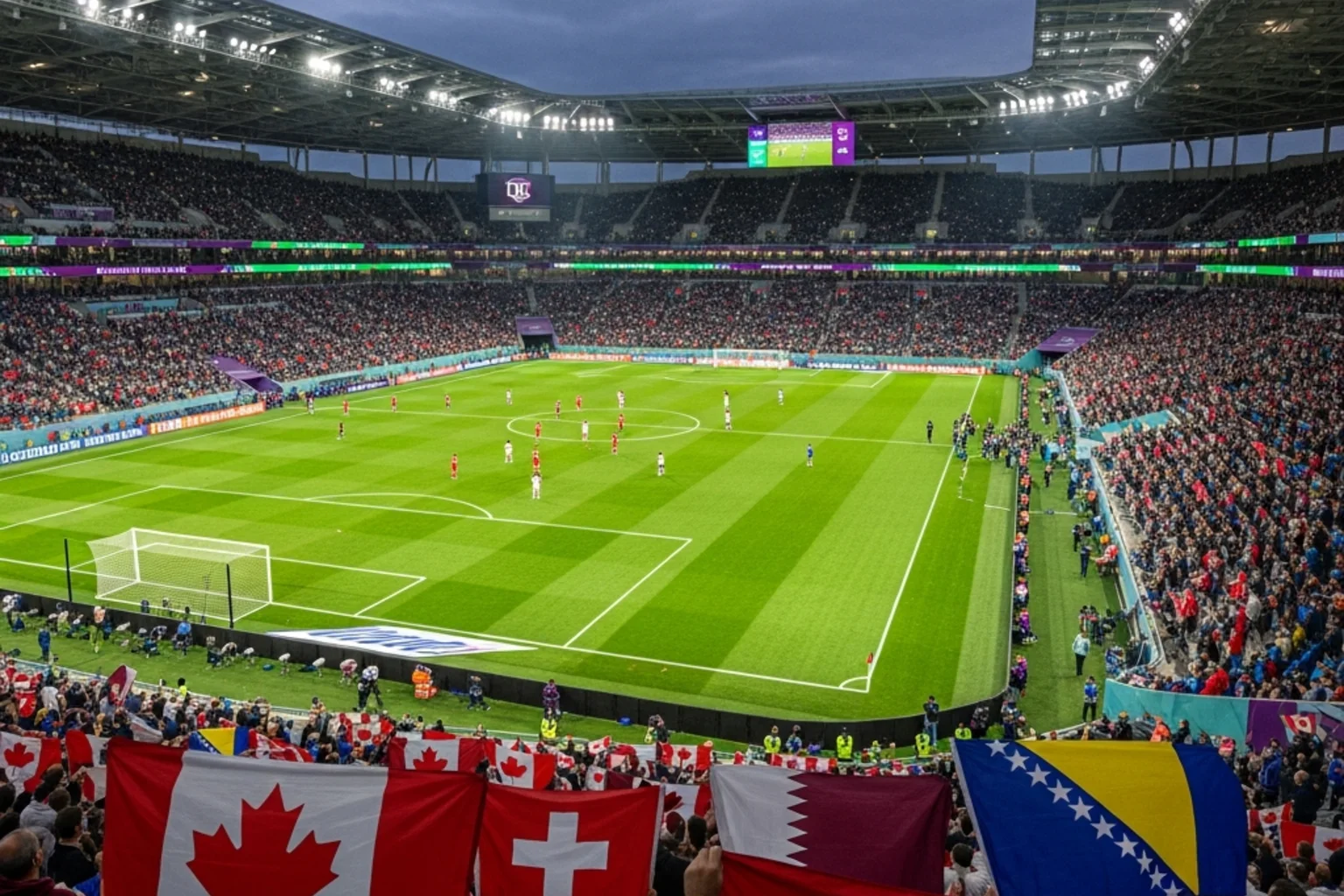
I have covered dozens of World Cup groups in my nine years analyzing international tournaments, and Group B of the 2026 edition presents something I have never seen before – a host nation with a genuine path to winning their group rather than just surviving it. Canada draws Switzerland, Qatar, and Bosnia and Herzegovina in what looks manageable on paper, but the details reveal complexity that smart bettors need to understand before placing a single wager.
This group features a fascinating mix of narratives. You have the host nation playing all three matches on home soil, the reigning Asian Cup champions trying to prove their 2022 home tournament was no fluke, a Swiss side that has become the model of tournament consistency, and a Bosnian team fresh off one of the biggest upsets in qualifying history. Four very different betting profiles require four distinct analytical approaches.
The group kicks off June 12 at BMO Field in Toronto when Canada faces Bosnia and Herzegovina, and concludes June 24 in Vancouver with Switzerland taking on the hosts in what could be a straight shootout for top spot. Between those dates, the permutations will shift constantly – making Group B one of the more interesting betting environments of the entire group stage.
Group B Teams at a Glance
My first trip to cover Bosnia was in 2014 when they qualified for their maiden World Cup in Brazil. The atmosphere in Sarajevo when Edin Dzeko scored against Argentina was something I will never forget – raw, desperate hope from a footballing nation that had waited so long. They lost that match 2-1 and finished bottom of their group, but the experience of watching a country discover World Cup football stays with you.
Switzerland sits atop this group as the FIFA ranking favourite, currently positioned around 15th globally. The Swiss have reached the knockout rounds in five consecutive major tournaments – Euro 2016, World Cup 2018, Euro 2020, World Cup 2022, and Euro 2024. That consistency is not accidental. Under various managers, Switzerland has developed a tournament identity built on defensive organization, set-piece efficiency, and the ability to raise their level against elite opposition. Their destruction of Italy in the Euro 2020 round of 16 and competitive showing against England at Euro 2024 demonstrate a team that belongs in the conversation among Europe’s second tier.
Canada enters ranked around 40th in the world, which undersells their current quality. The golden generation featuring Alphonso Davies, Jonathan David, and Tajon Buchanan represents the strongest squad in Canadian football history. Their 2022 World Cup appearance ended without a point, but they competed admirably against Belgium and Croatia before collapsing against Morocco. Home advantage in 2026 changes everything – BMO Field and BC Place will be hostile environments for opponents, and the psychological lift of playing a World Cup in your own country cannot be overstated.
Qatar comes in ranked around 35th, having won back-to-back Asian Cups in 2019 and 2023. Their home World Cup in 2022 was a disaster – three losses including a 2-0 defeat to Ecuador in the opening match – but that tells an incomplete story. The Qataris built their program for one tournament and reached it unprepared for the pressure. Since then, they have rebuilt under different tactical approaches and proved on neutral ground in China that they can compete at the highest Asian level.
Bosnia and Herzegovina arrives ranked between 50th and 60th but riding the momentum of their sensational playoff victory over Italy. In March 2026, they went to Rome and won 1-0, becoming one of the few teams ever to eliminate Italy from World Cup qualification. That result alone makes them dangerous – a team that believes they can beat anyone on their day.
Canada – Hosts with Home Advantage
The last time I watched Canada play a meaningful match at BMO Field, the roof nearly came off during their 2-0 victory over the United States in World Cup qualifying. That night in January 2022, with snow falling and 30,000 Canadians creating an atmosphere I had never experienced in CONCACAF, I understood what home advantage means for this team. It is not just familiarity with the pitch – it is the transformation of normally polite Canadian fans into something genuinely intimidating.
Jesse Marsch took over as head coach following Canada’s 2022 World Cup exit, bringing his pressing-heavy American tactical approach to a squad that had previously played more conservatively under John Herdman. The transition has been uneven but encouraging. Marsch demands high energy output and aggressive defending in the opposition half, which suits players like Davies and Buchanan who thrive in transition.
The Alphonso Davies situation hangs over everything. The Bayern Munich star suffered an ACL injury in early 2025, and his recovery timeline points toward being fit for the tournament but short of match sharpness. Davies at 80% remains one of the most talented players in this group, but Canada’s tactical flexibility suffers enormously without him at full capacity. Watch the friendlies in May and early June closely – if Davies is starting and completing 90 minutes, Canada’s odds improve meaningfully.
Jonathan David provides the goal threat that Canada lacked historically. His move from Lille to Juventus in January 2025 placed him in a higher-pressure environment, and he has responded with improved all-around play even if the goals have come slightly less frequently in Serie A than they did in Ligue 1. David carries Canada’s Golden Boot ambitions – at +15000 for the tournament, he represents interesting long-shot value if Canada makes a run to the quarterfinals.
Canada’s schedule sets up favourably: Bosnia first in Toronto, Qatar second in Vancouver, Switzerland third in Vancouver. Two of three matches in Vancouver means the team can settle into BC Place after a Toronto opener, reducing travel fatigue in a tournament where every small advantage matters. The Bosnia match is crucial – a win there puts Canada in control of their destiny against Qatar, potentially meaning the Switzerland match becomes about winning the group rather than surviving.
Switzerland – Group Favourites
I remember sitting in the Allianz Arena press box when Switzerland knocked France out of Euro 2020 on penalties. Yann Sommer saving Kylian Mbappe’s spot kick was one of those moments that defines a nation’s footballing identity. The Swiss do not have France’s talent or Germany’s depth, but they have something more valuable in tournament play – the absolute certainty that they will compete in every match regardless of opponent.
Murat Yakin has continued the steady progression that Vladimir Petkovic began, maintaining Switzerland’s 3-4-3 system while incorporating younger talents like Dan Ndoye and Zeki Amdouni into key roles. Granit Xhaka remains the heartbeat of the midfield at 33, though his age means Switzerland must manage his minutes carefully across a potentially seven-match tournament. The experienced spine of Xhaka, Manuel Akanji, and Ricardo Rodriguez provides the tournament know-how that so often proves decisive in group stage football.
The Swiss qualifying campaign was dominant – they finished top of a group containing Israel, Romania, Kosovo, Belarus, and Andorra, winning eight of ten matches and conceding only four goals in the process. That defensive record speaks to their organizational quality, but the opposition level requires context. Switzerland’s true tests came at Euro 2024, where they reached the quarterfinals before losing to England on penalties – another reminder that this team refuses to be blown out.
Betting on Switzerland to win Group B at -110 represents fair value rather than a significant edge. They should handle Qatar and Bosnia comfortably, meaning the Canada match likely decides first place. If that match finishes level, Switzerland probably takes the group on goal difference given their expected margins against the other two teams. The Swiss rarely blow teams out but equally rarely concede, making them ideal favourites in a group like this.
Qatar – Former Hosts
Walking around Doha during the 2022 World Cup, I kept meeting Qatari fans who seemed more interested in the spectacle than the football. The national team’s performances – three losses, one goal scored – confirmed what many suspected: Qatar had peaked too early in their tournament preparation and wilted under the pressure of a home World Cup. By the time they faced Senegal in their final group match, the stadium was half-empty with locals already checked out.
The rebuilding since 2022 has been substantial. Qatar won the 2023 Asian Cup in convincing fashion, beating Jordan 3-1 in the final on neutral ground in China. That tournament demonstrated that the core group of players developed through the Aspire Academy remains capable of elite performances when the pressure is external rather than existential. Akram Afif won the Asian Cup Golden Ball and has developed into a genuinely dangerous attacking player, while Almoez Ali provides physical presence up front that European defences often struggle with.
The challenge for Qatar in Group B is familiar – can they compete against European and CONCACAF opposition at a World Cup? Their only historical World Cup appearance produced zero points and exposed significant gaps in defensive organization against top-tier opposition. Switzerland and Canada represent exactly the type of teams that dismantled Qatar in 2022, making their path out of this group extremely narrow.
Qatar opens against Switzerland, the worst possible draw for their confidence. A likely loss there means the Canada match becomes must-win, but traveling to Vancouver to face a host nation riding group stage momentum is not a winning proposition. The books have Qatar at +3500 to win the group, which reflects their outsider status accurately. Their ceiling in this group is third place with perhaps 3 points from a victory over Bosnia – enough to have a mathematical chance at one of the eight best third-place spots but nothing resembling confidence.
Bosnia – The Italy Slayers
The phone call from a colleague in Sarajevo on the night Bosnia beat Italy still makes me smile. He was literally crying – not from sadness but from the overwhelming emotion of watching his country accomplish something historic. Italy had not lost a World Cup qualifying playoff in decades. Bosnia went to Rome and won through Edin Dzeko’s 82nd-minute goal, and suddenly a squad that had seemed destined for another near-miss was going to the World Cup.
That victory transformed Bosnian football overnight. The generation that missed out in 2018 and 2022 qualifying – Miralem Pjanic, Edin Dzeko, Sead Kolasinac – gets one final chance at World Cup glory. Dzeko will be 40 during the tournament, but his header against Italy proved he can still rise in big moments. The question is whether Bosnia can find that same level against Canada in a group stage match rather than a playoff elimination scenario.
Bosnia’s tactical setup under head coach Sergej Barbarez emphasizes defensive solidity and quick transitions. They do not have the individual quality of Switzerland or the depth of Canada, but they have tournament-tested veterans who understand how to grind out results. Pjanic dictating from midfield remains their creative fulcrum, though his legs at 36 require careful match management.
The opening match against Canada in Toronto is arguably the most important 90 minutes in Bosnian football history since Brazil 2014. A positive result there – even a draw – would transform Bosnia’s group stage dynamics. Lose, and they face Switzerland and Qatar needing points from both matches to have any realistic path forward. The books showing Bosnia at +270 to win the group feel generous given the Italy result, but the price reflects the reality that they must beat Canada to have any chance – and doing so in Toronto against a motivated host nation is asking a lot.
Group B Match Schedule
The schedule architects placed Canada’s matches strategically across their two host venues, giving the home nation optimal rest and travel conditions while opponents must adjust to different time zones and environments. Understanding this schedule is essential for live betting throughout the group stage.
June 12 brings the opening fixture at BMO Field in Toronto – Canada versus Bosnia and Herzegovina with a 3:00 PM Eastern kickoff. This timing favours Canada significantly, as Bosnia will have traveled from Europe while the hosts play in conditions they know intimately. Toronto in mid-June offers comfortable temperatures in the low 20s Celsius, though afternoon sun could be a factor depending on cloud cover.
The same day sees Switzerland face Qatar in Houston at NRG Stadium, a 6:00 PM Central kickoff. Both teams travel from abroad for this one, creating neutral territory despite the US venue. Houston in June means humidity and temperatures pushing 30 degrees Celsius – conditions that favour the Qataris who train in similar environments year-round.
June 17 brings the second matchday with Switzerland taking on Bosnia in Seattle at Lumen Field. The 3:00 PM Pacific kickoff allows European television prime time coverage while giving both teams five days rest from their openers. Qatar and Canada clash in Vancouver at BC Place with a 6:00 PM Pacific start, giving Canada their home advantage in what should be a pivotal match for both teams.
The final matchday on June 24 could decide everything. Canada plays Switzerland at BC Place in Vancouver with a 3:00 PM Pacific kickoff, while Bosnia faces Qatar in Atlanta at Mercedes-Benz Stadium with a 3:00 PM Eastern start. The simultaneous kickoffs eliminate any possibility of teams knowing what they need before their matches conclude – ensuring both fixtures feature genuine competitive tension.
Head-to-Head Records
I pulled my historical database for these matchups and found some surprising gaps – several of these teams have rarely or never faced each other in competitive fixtures, making head-to-head analysis less predictive than you might expect. The blank spaces in the history actually create betting opportunities, as bookmakers often rely on historical data that simply does not exist here.
Canada and Switzerland have met just twice in senior international football, both friendlies from over a decade ago. The Swiss won both – a 2-1 victory in 2010 and a 1-0 win in 2013 – but those squads bear zero resemblance to the current teams. Neither Davies nor David had made their senior debuts, and Switzerland’s personnel has turned over almost entirely. These historical results provide no meaningful predictive value.
Canada and Bosnia have never played each other at senior level. This complete absence of head-to-head history means the opening group match will be their first competitive meeting ever. Both teams must prepare based entirely on scouting reports and video analysis rather than any lived experience of facing these specific opponents. For bettors, this suggests the opening match could produce unusual patterns as teams figure each other out in real time.
Canada and Qatar met in the 2022 Arab Cup semifinal, where Qatar won 2-1. However, Canada fielded a heavily experimental squad for that tournament while focused on World Cup preparation. The teams also crossed paths in various friendlies during Qatar’s long World Cup buildup period, with mixed results that again provide limited predictive insight for 2026.
Switzerland and Qatar have met three times, with Switzerland winning all three – including a 3-1 friendly victory in 2021. The Swiss have historically handled Asian opposition comfortably, and nothing in Qatar’s recent form suggests that pattern will reverse. Switzerland versus Bosnia shows more interesting history, with a 2-0 Swiss victory in Euro 2024 qualifying suggesting clear European hierarchy.
Bosnia and Qatar have never met competitively, making their final group match another fixture with zero historical precedent. The permutations going into that match could create wild swings in both teams’ approaches depending on other results, making it a potentially volatile betting environment.
Group B Betting Odds
The current market for Group B tells a clear story – Switzerland are expected to win, Canada should advance in second, and neither Qatar nor Bosnia is given much chance of progression. But within those broad expectations lie significant value opportunities for those willing to dig deeper than surface-level analysis.
Switzerland to win Group B sits at -110 across most Canadian sportsbooks, implying roughly 52% probability. This feels accurate given their tournament pedigree and favourable matchups against Qatar and Bosnia. The price offers no inherent value but represents a safe anchor for group-based parlays.
Canada at +260 to win the group represents the interesting play. The hosts need to beat Switzerland in the final group match – a tall order but far from impossible at BC Place with 55,000 fans creating a hostile atmosphere. If Canada handles Bosnia and Qatar convincingly while Switzerland drops points against one of those teams, the group could come down to goal difference. Canada’s attacking quality makes them capable of running up scores against weaker opposition.
Bosnia at +270 offers similar upside to Canada but with significantly more risk. They need to beat Canada in Toronto to have any realistic path, and that opening match looks like a coin flip at best. If you believe the Italy momentum carries forward and Bosnia steals points from Canada, this price becomes attractive. But momentum from a March playoff rarely survives until June tournament football.
Qatar at +3500 is a long shot that probably does not hit. They face the toughest opener against Switzerland, must then travel to Vancouver to play Canada, and likely need at least 6 points to have any chance at third place qualification. The pathway simply has too many obstacles for serious investment at this price.
For individual match markets, Canada to beat Bosnia at home opens around -150, Switzerland to beat Qatar around -200, and the Canada-Switzerland decider projects close to even money. Live betting during these matches could offer better value than pre-match prices as the actual quality gap becomes clear through match action.
Group B Predictions
After analyzing the four teams extensively, factoring in recent form, historical tournament performance, and the specific dynamics of these matchups, I see a clear hierarchy but with enough uncertainty to create betting interest throughout the group stage.
My projected final standings have Switzerland finishing first with 7 points from two wins and a draw, Canada second with 6 points from two wins and one loss to Switzerland, Bosnia third with 3 points from a win over Qatar, and Qatar fourth with no points. This represents the most likely outcome but certainly not the only one.
The scenario where Canada wins the group requires them to beat Switzerland on June 24 and for Switzerland to draw or lose one of their other matches. Switzerland drawing Bosnia in Seattle is not impossible – Lumen Field’s wet conditions and Bosnia’s defensive organization could produce a low-scoring affair. If that happens and Canada wins their first two matches convincingly, the final day becomes a genuine competition for top spot rather than a formality.
Bosnia advancing is the dark horse scenario that would upend predictions across every sportsbook. They need 4 points minimum, probably requiring a win over Canada and at least a draw against Switzerland or Qatar. The pathway exists but depends entirely on the opening match in Toronto. I give this perhaps a 15% probability – low but not negligible given the Italy precedent.
For my betting approach to this group, I am focusing on Canada to advance (-350) as the safest play, Switzerland versus Canada draw (+250) as a value play if you believe neither team will risk everything in the final match, and Bosnia under 2.5 total goals in the group (+150) as a reflection of their defensive style and limited attacking resources. The detailed Group B predictions expand on specific match betting angles.
