

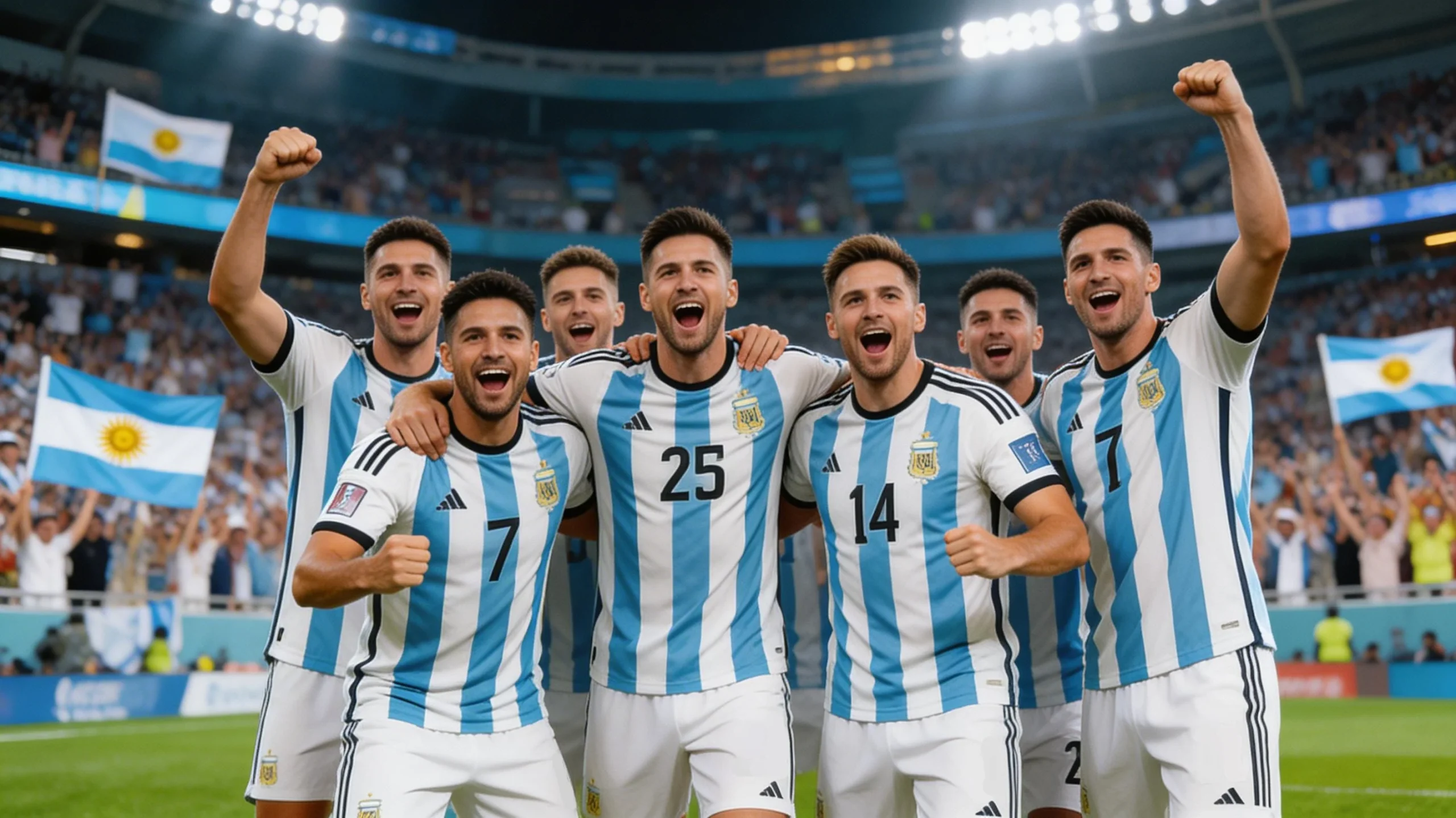
Three hundred and sixty-one days after lifting the trophy in Lusail, I watched Lionel Messi accept his Inter Miami jersey and wondered if we’d seen his last World Cup. Now, with June 2026 approaching, that question remains unanswered – and it defines everything about Argentina’s tournament betting analysis. The defending champions carry the emotional weight of a generation’s greatest player potentially making his final tournament appearance, complicating what should be straightforward favourite analysis.
Argentina enters World Cup 2026 as the team to beat – not just because they won in Qatar, but because the system Lionel Scaloni built transcends individual brilliance. The Albiceleste dismantled opponents through collective pressing, tactical discipline, and an emotional unity that produced iconic moments when the pressure peaked. Whether that system survives Messi’s potential absence or diminished role shapes every projection I’m building for this tournament.
Defending the 2022 Crown
The mathematics of World Cup title defence don’t favour Argentina. Only two nations have successfully defended the trophy – Italy (1934-1938) and Brazil (1958-1962) – in ninety-two years of tournament history. That 10.5% historical success rate exists for reasons that apply directly to Argentina’s situation: the intense pressure of defending, the target on champions’ backs, and the aging core that won the previous tournament.
But Argentina’s situation differs from typical defending champions in important ways. Their 2022 triumph wasn’t built on a generation reaching peak and declining – several key players were young enough that 2026 represents their prime. Enzo Fernández was 21 in Qatar. Julián Álvarez was 22. Cristian Romero had just turned 24. The spine of this team can theoretically improve while adding another World Cup cycle of experience.
What concerns me about title defence is the Messi factor. Argentina’s 2022 tournament combined collective excellence with Messi’s individual genius at precisely the right moments – the penalty against France in the final, the passes that unlocked defensive blocks, the leadership presence that calmed teammates in pressure situations. If Messi is absent or diminished in 2026, Argentina becomes a different team. Still excellent, but missing the X-factor that separated them from France in that iconic final.
The post-Qatar period has shown Argentina can function without peak Messi. The 2024 Copa América title came despite Messi’s injury absence in later rounds, suggesting Scaloni’s system doesn’t completely depend on one player. But World Cup football demands more than Copa América – the best teams in the world prepare specifically for Argentina, and the gap between good and great becomes razor thin when elimination looms.
Scaloni’s management of expectations matters enormously. He’s maintained squad harmony despite the immense pressure that follows World Cup triumph. The core group stayed together through friendlies and qualifying, building the collective understanding that tournament success requires. If any manager can navigate title defence psychology, Scaloni – who played for Argentina and understands the pressure viscerally – has the background to succeed.
Lionel Messi – Final World Cup?
The question hangs over every Argentina analysis, and I’ve learned that projecting Messi’s decisions produces more embarrassment than insight. After the 2022 final, he suggested this might be his last tournament. Then he won the Copa América in 2024 and hinted at continuing. His Inter Miami contract runs through 2025 with extension options. At 38 years old during the 2026 tournament, he’d be the oldest outfield player to feature prominently for a tournament favourite since the 1994 World Cup.
What I can project is Messi’s potential contribution if he plays. His role has evolved from the electric dribbler who destroyed defences individually to the orchestrator who controls tempo and creates through vision rather than pace. This evolution actually suits tournament football – the physical demands of seven matches in four weeks require conservation of energy that a younger, more explosive Messi wouldn’t accept.
The Inter Miami context matters. Messi has thrived in MLS – the lower physical intensity allows him to dominate matches through pure quality without the recovery demands of European football. His goal and assist numbers remain extraordinary. Whether that MLS form transfers to World Cup intensity against elite defenders remains uncertain, but his baseline quality hasn’t disappeared despite the league’s reputation.
For betting purposes, I’m building models that include Messi at reduced effectiveness – approximately 70% of his 2022 contribution. This accounts for age-related decline while acknowledging that 70% of peak Messi exceeds most players at their best. If Messi announces he’s not participating, these projections require complete reconstruction. If he declares full commitment and shows fitness in pre-tournament matches, the 70% estimate might prove conservative.
The emotional dimension can’t be quantified but exists in my analysis. If Messi announces this as his definitive final tournament, Argentina’s squad will play with motivation that transcends normal competitive drive. The desire to send Messi out with another trophy could produce performances that rational projection misses. I watched similar dynamics with Zidane’s France in 2006 – a team that overperformed statistical expectations through collective will centred on their retiring legend.
Squad Overview
Remove Messi from the equation, and Argentina’s squad still ranks among the tournament’s three deepest. The core group that won in Qatar has aged into prime years rather than declining. The supporting cast has improved through European development that adds quality to positions where 2022 showed weakness.
Enzo Fernández has established himself as the midfield conductor that modern football demands. His Chelsea move preceded a difficult adaptation period, but 2024-25 showed the quality that justified the record transfer fee. His ability to receive under pressure, switch play with diagonal passes, and arrive in the box for goals makes Argentina’s midfield among the tournament’s best. At 25 years old during the World Cup, Fernández represents a decade of future dominance.
Julián Álvarez provides the attacking threat that Messi once exclusively provided. His development at Manchester City – learning from Guardiola while competing with Haaland for minutes – produced a complete forward who can play as a nine, as a shadow striker, or as a wide forward. His work rate and pressing intensity suit Scaloni’s system perfectly. If Messi is diminished or absent, Álvarez becomes Argentina’s primary attacking focus.
The defence has only improved since Qatar. Cristian Romero and Lisandro Martínez form a centre-back partnership that combines aggression, recovery pace, and aerial dominance. Both play in the Premier League’s intense environment, maintaining match sharpness that some defenders from lesser leagues lack. The fullback positions feature depth – Nahuel Molina on the right, Nicolás Tagliafico or younger options on the left.
Goalkeeper Emiliano Martínez deserves special mention. His penalty shootout heroics in Qatar – the psychological warfare, the crucial saves – made him an iconic figure. But beyond the drama, his shot-stopping ability and command of the penalty area provide genuine world-class security. Argentina concedes few goals partly because opponents know scoring past Martínez requires exceptional quality.
Depth positions that concerned me in 2022 have resolved. Mac Allister’s development at Liverpool adds midfield creativity. Nicolás González provides wide attacking options beyond the established starters. The young players emerging – Luka Romero, Alejandro Garnacho if selected – offer talent that previous Argentine generations lacked as backup options.
Scaloni’s Tactical Blueprint
Before Lionel Scaloni took charge, Argentina cycled through managers who couldn’t solve the problem of building a team around Messi while remaining collectively organized. Scaloni’s genius was recognizing that Messi didn’t need a team built around him – he needed a team that functioned without him so he could add to a working system rather than compensate for a broken one.
The formation flexibility starts from a 4-3-3 or 4-4-2 base but adjusts depending on opposition and match situation. Against deep-defending opponents, Argentina pushes fullbacks high and inverts wingers to create overloads. Against pressing teams, they build methodically through midfield, using Enzo Fernández as the pivot who determines whether to go direct or circulate possession.
Pressing intensity has become Argentina’s defining characteristic. They won the World Cup partly by outworking opponents in the middle third – Álvarez’s relentless chasing, De Paul’s box-to-box coverage, Messi’s intelligent positioning that forced passes into pressing traps. This collective effort meant opponents rarely settled into comfortable possession patterns. The pressing triggers – when to chase, when to contain – show coaching detail that casual observers miss but betting analysis must account for.
The transition game, when Argentina win possession in midfield, produces their most dangerous moments. Álvarez’s runs behind defence combine with Messi’s through-balls (or Fernández’s increasingly dangerous passing) to create three-on-three situations where Argentine technical quality typically wins. This pattern produced several goals in Qatar and remains the primary attacking mechanism.
Defensive shape deserves equal attention. Argentina’s 4-4-2 defensive block, which forms when out of possession regardless of attacking formation, showed remarkable discipline throughout the 2022 tournament. The midfield four slides compactly, forcing opponents wide where Argentina’s fullbacks can engage without leaving central gaps. Romero and Martínez’s aggression allows them to step into challenges rather than always dropping deep, disrupting attacking rhythm before it develops.
Set pieces have become an Argentine strength under Scaloni. Dead-ball situations produced crucial goals throughout their World Cup campaign – De Paul’s deliveries, Romero’s aerial threat, the rehearsed movements that create space in crowded boxes. Against knockout-round opponents who defend deep, set pieces often decide matches. Argentina’s proficiency provides an edge that pure possession teams lack.
Scaloni’s in-game management showed exceptional quality throughout 2022 and subsequent tournaments. His substitutions against France in the final – bringing fresh legs at the right moments, adjusting shape to respond to French pressure – demonstrated tactical awareness that matches the best tournament managers. Argentina don’t panic when matches go against them, and that composure comes from collective trust in the manager’s adjustments.
Group J Preview
Argentina’s draw places them in Group J alongside Algeria, Austria, and one team still to be determined through qualification playoffs. The group presents manageable challenges – no traditional powerhouse, but no guaranteed easy points either.
Algeria represents Africa’s most interesting qualifier from a betting perspective. Their squad includes European-based players who’ve developed considerably since their last World Cup appearance. The coach has implemented attacking football that produced convincing qualification results. Their 2014 World Cup performance showed capability to compete with major nations – that tournament’s round of 16 appearance came through group stage results that exceeded expectations. While they shouldn’t threaten Argentina’s group position, Algeria could frustrate opponents and create moments that test composure.
The Algerian support base in North America adds an interesting dynamic. France’s large Algerian diaspora produces passionate away support when Algeria plays in European tournaments – similar communities exist in Quebec and elsewhere in Canada. While this doesn’t directly help Algeria against Argentina, it could create atmospheric challenges in group matches that neutral observers might underestimate.
Austria brings European tactical discipline to the group. Their qualifying campaign showed organization and threat from set pieces that can trouble better teams. The physical approach – winning aerial duels, contesting second balls – provides different challenges than Argentina typically faces in CONMEBOL competition. Manager Ralf Rangnick has implemented pressing principles that could disrupt Argentina’s build-up play, even if Austria lacks the individual quality to truly threaten.
Austria’s ceiling is probably third place, but they’ll make both group leaders work for victories. Their central midfield, featuring Bundesliga players with tactical intelligence, can frustrate possession-based opponents. The question is whether Austria can sustain their pressing intensity across ninety minutes against Argentina’s patient build-up. Historical evidence suggests not, but the 2026 tournament’s expanded format means Austria faces less pressure than previous World Cups demanded.
The TBD position could affect Argentina’s preparations depending on which team emerges. The playoff process will clarify this by late March 2026, allowing time for tactical preparation but creating uncertainty in current betting models. If a capable team emerges from the playoffs, Group J becomes slightly more competitive. If a weaker qualifier fills the slot, Argentina’s path simplifies further.
Argentina should win this group comfortably. Their -350 to -400 odds for group victory reflect this expectation accurately – no value in backing them, but also no reason to fade them. The interesting markets involve specific match totals and first-half/full-time bets where Argentina’s tendency to control matches produces predictable patterns.
Argentina World Cup Odds
The defending champions sit between +350 and +500 across major books, making them the outright favourite or joint-favourite with France depending on the timing and sportsbook. The implied probability of 17-22% reflects both their 2022 triumph and the uncertainties surrounding Messi’s participation and effectiveness.
I find slight value in Argentina outright at +450 or longer. The price accounts for Messi uncertainty while perhaps undervaluing the system Scaloni has built. Even without peak Messi, Argentina’s squad depth, collective quality, and tournament experience suggest a semifinal floor and final ceiling that the odds don’t fully capture.
The value calculation depends heavily on Messi news. If he commits unequivocally to the tournament with fitness demonstrated in pre-tournament matches, Argentina at +450 becomes attractive. If retirement rumours persist or injury concerns emerge, the current price is accurate or even generous to Argentina.
To reach semifinals at approximately -200 offers more consistent value than the outright market. Argentina’s group draw and likely bracket position should provide a path to the final four that avoids facing France or Brazil until later rounds. This price reflects approximately 65% probability, which my models suggest undersells Argentina’s actual advancement chances.
Player markets deserve attention for Argentina bets. Julián Álvarez at +1500 to +2000 for Golden Boot offers value that most tournament observers haven’t fully recognized. He’ll likely start every match, receives penalty opportunities when Messi is absent, and could score 5-6 goals if Argentina reaches the final. Those numbers compete for Golden Boot contention.
Betting on the Defending Champions
Argentina’s betting profile differs from other favourites because their floor is higher. They’ve demonstrated ability to win knockout matches under maximum pressure – something Brazil, France, and England have recently failed to do. This experience matters in tournament betting, where close matches often decide advancement.
The specific opportunities I’m targeting begin with match-by-match unders in group play. Argentina tends to control matches without scoring excessively – their World Cup qualifying goals per game averaged around 2.0 despite dominant possession. Against Algeria and Austria, expect 1-0 or 2-0 scorelines where Argentina’s defence limits chances without pushing for unnecessary attacking risk.
First-half draws offer consistent value when Argentina faces organized opponents. They tend to start matches cautiously, probing for weaknesses before accelerating in the second half when opponents tire. The Algeria and Austria matches both fit this pattern – first-half 0-0 or 1-0 Argentina with the match decided after halftime.
Avoid Argentina clean sheet bets at short prices. While their defence is excellent, the tournament format’s accumulation of matches creates fatigue that elite attackers can exploit. One goal conceded across seven matches is unrealistic – pricing that reflects one clean sheet in group play seems more appropriate.
The emotional hedge: small positions on Argentina to win the tournament work as insurance against being wrong about Messi’s participation. If he announces full commitment and plays brilliantly, the current +450 will tighten significantly. Locking in now provides value that disappears with positive Messi news.
Argentina’s World Cup Legacy
Three World Cup titles – 1978, 1986, 2022 – establish Argentina among football’s elite nations. Each triumph carried distinctive characteristics that reflect the era’s football and the country’s circumstances.
The 1978 home tournament produced Argentina’s first World Cup success amid political controversy that still shadows the achievement. The military junta’s involvement in hosting tainted celebrations even as Mario Kempes’ goals and César Menotti’s attacking football captured global attention. That generation established Argentina as a World Cup power capable of challenging the European and Brazilian establishments.
Diego Maradona’s 1986 remains the defining individual World Cup performance. The Hand of God goal obscured the legitimate genius – the second goal against England, the semifinal dismantling of Belgium, the passes that created goals throughout the tournament. Maradona carried that team in ways that create the comparison every Argentine player since has faced. His shadow extends to Messi’s pressure in ways few outside Argentina fully appreciate.
The 2022 triumph finally provided Messi’s answer to the Maradona legacy. The Qatar campaign demonstrated that Messi could lead Argentina to World Cup glory – the last box unchecked in his career. The emotional release, for Messi personally and for Argentine football collectively, transcended normal sporting achievement. The nation embraced the victory with intensity that reflected decades of near-misses and Maradona comparisons finally resolved.
Now Argentina enters 2026 seeking something unprecedented in their history: consecutive World Cup titles. The 1978 and 1986 squads couldn’t sustain excellence across tournament cycles. The post-Maradona generations failed repeatedly in finals and quarterfinals. This generation – young enough to remain elite, experienced enough to handle pressure, led by history’s greatest player – has the opportunity to achieve what no Argentine side has managed.
The pressure of defending changes everything. In 2022, Argentina entered as perennial underachievers seeking redemption. In 2026, they arrive as targets with every opponent raising their intensity against the champions. Managing that psychological shift while maintaining the collective hunger that produced 2022’s triumph represents Scaloni’s greatest challenge. Among all World Cup 2026 teams, Argentina carries the unique burden of defending champion expectations.
