

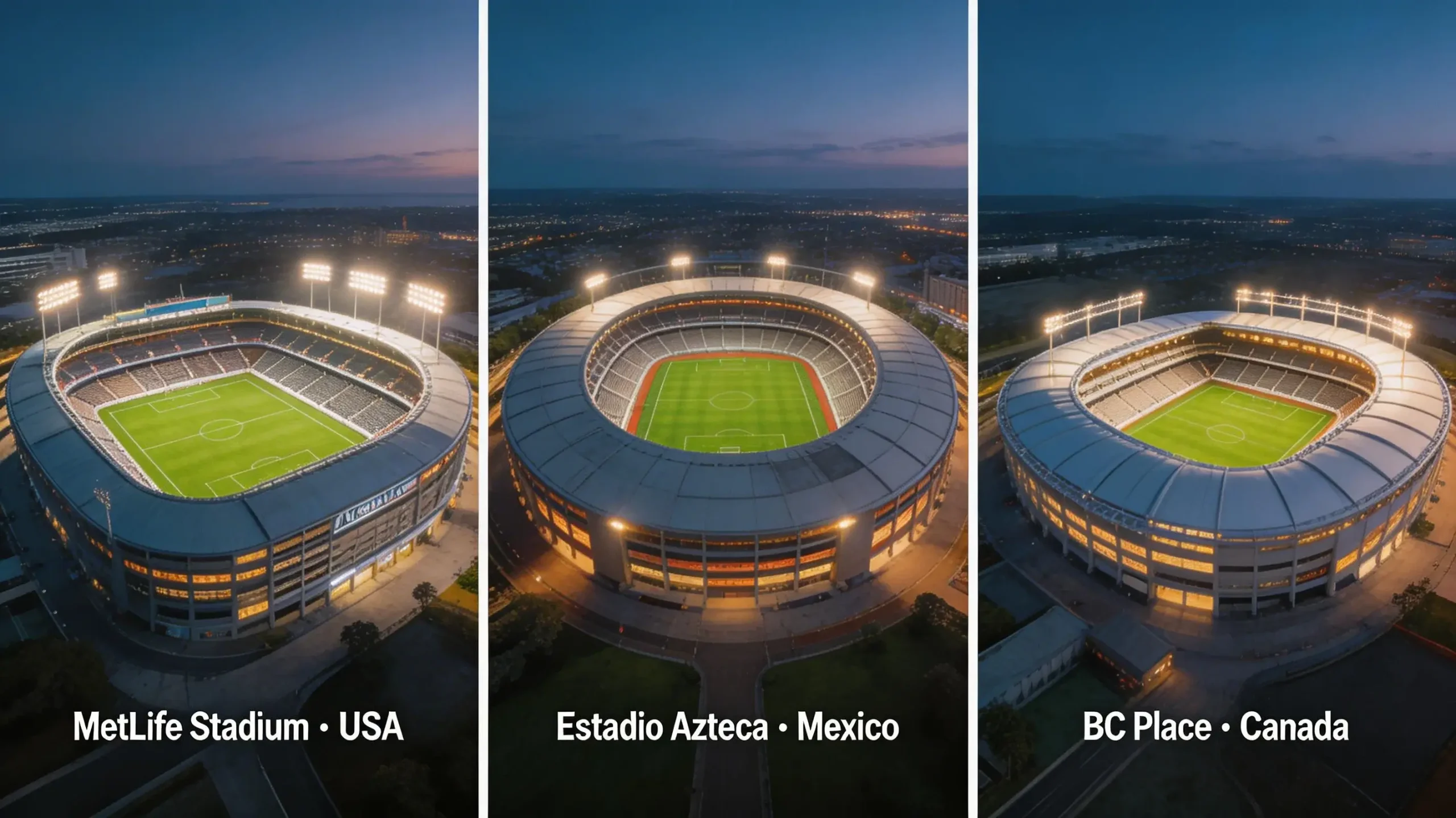
Standing at midfield in MetLife Stadium during a 2024 NFL scouting visit, I tried to imagine 80,000 fans watching a World Cup final rather than Giants football. The sightlines work differently for soccer – the pitch sits lower, the corner flags feel impossibly distant from upper deck seats, and the atmosphere carries sound patterns that NFL broadcasts never capture. That moment clarified something I had been processing since FIFA announced the 16 venue selections: these stadiums will shape the 2026 World Cup in ways that go far beyond capacity numbers and luxury suite counts.
The tri-nation tournament spreads across the United States, Mexico, and Canada in a geographical footprint unprecedented in World Cup history. Eleven American stadiums, three Mexican venues, and two Canadian hosts create a tournament that spans four time zones and 4,000 kilometres from Vancouver to Miami. Teams will fly more miles between group stage fixtures than any previous World Cup participants. Fans will navigate wildly different climates, altitudes, and urban environments. Bettors tracking these factors gain edges that single-nation tournament analysis never provided.
Each stadium carries distinct characteristics that affect match outcomes. Estadio Azteca’s 2,200-metre altitude challenges sea-level European teams. Miami’s June humidity creates physical demands absent from Vancouver’s temperate climate. Lumen Field in Seattle offers the loudest crowd environment in American football, while AT&T Stadium in Arlington operates with a retractable roof that eliminates weather variables entirely. Understanding these venue dynamics is not optional for serious World Cup analysis – it is foundational.
What follows provides comprehensive breakdown of all 16 World Cup 2026 stadiums, organized by host nation. I have visited eleven of these venues during various football and soccer events, researched the others through architectural analysis and event reports, and synthesized that knowledge into betting-relevant stadium profiles. From MetLife’s final hosting duties to Azteca’s opening match significance to BMO Field’s Canadian national team fortress environment, these venues tell the story of what the 2026 World Cup will actually look and feel like.
16 Stadiums Across Three Nations
FIFA’s venue selection process for 2026 began with 41 candidate cities submitting bids and concluded with 16 selections that balanced competitive considerations against political, economic, and infrastructure realities. The distribution – eleven in the United States, three in Mexico, two in Canada – reflects both population distribution and the tournament’s American-centric commercial orientation.
The American stadium dominance creates the tournament’s primary structural feature: most matches happen in venues built for NFL football rather than soccer. NFL stadiums seat 65,000 to 82,000 spectators in configurations designed for gridiron sightlines, not association football pitch dimensions. Temporary seating, sight line adjustments, and pitch installations will transform these venues, but their fundamental design remains American football-centric. This matters because crowd proximity to the action – a defining feature of European and South American football stadiums – will vary significantly across the 16 hosts.
Mexico’s three venues – Estadio Azteca in Mexico City, Estadio BBVA in Monterrey, and Estadio Akron in Guadalajara – provide the tournament’s only traditional football-specific stadium environments. These venues host Liga MX matches weekly and require minimal reconfiguration for World Cup play. Their atmospheres will feel authentically Latin American in ways the NFL conversions cannot replicate.
Canada’s two venues – BMO Field in Toronto and BC Place in Vancouver – represent the tournament’s smallest host capacities at 45,500 and 54,000 respectively. Both underwent World Cup preparation upgrades, with BMO Field’s temporary expansion adding 13,000 seats to its permanent 30,000 capacity. The Canadian venues host all three of Canada’s group stage matches, creating home advantage dynamics that could prove decisive for the Reds’ advancement hopes.
Match distribution across these 16 venues follows clear patterns. Each stadium hosts at least four matches during the group stage, with larger venues (MetLife, SoFi, AT&T) receiving additional knockout round assignments. The final, third-place match, and both semifinals all occur in American venues. Mexico hosts the opening match at Azteca, creating the tournament’s symbolic beginning in North America’s most iconic football cathedral. Canada’s venues disappear from the bracket after group stage completion, limiting their knockout round hosting to potential Round of 32 matches.
United States – 11 Stadiums
The American hosting footprint spans from Massachusetts to California, Florida to Washington state. These eleven venues represent the largest collection of World Cup stadiums ever assembled in a single nation, exceeding Brazil’s twelve 2014 venues only because the tri-nation format concentrates tournament infrastructure in the primary host country. Each stadium brings distinct characteristics that shape match dynamics.
MetLife Stadium in East Rutherford, New Jersey hosts the tournament’s most significant match – the July 19 final. With 82,500 capacity (expandable for special events), MetLife represents American football excess applied to soccer. The venue’s New York metropolitan location provides global media access and international fan connectivity unmatched by any other American stadium. However, MetLife lacks a roof, making weather a variable for all matches hosted there. July New Jersey weather typically features high humidity and temperatures exceeding 30°C – conditions that favour teams accustomed to similar climates.
SoFi Stadium in Inglewood, California represents the tournament’s most technologically advanced venue. The $5 billion structure (the most expensive stadium ever built) features a translucent roof that allows natural light while blocking weather. Los Angeles hosting duties include semifinal matches, positioning SoFi as the pathway to the final for bracket survivors. The venue’s proximity to LAX simplifies international fan logistics, though Southern California traffic patterns will challenge matchday travel.
AT&T Stadium in Arlington, Texas provides the tournament’s most controlled environment. Jerry Jones’ retractable roof creation eliminates weather variables entirely when closed, and Texas heat management will likely keep it sealed for all World Cup matches. The Dallas-Fort Worth metropolitan area’s position as an American aviation hub creates accessibility advantages, while the stadium’s 80,000 capacity matches MetLife’s scale without MetLife’s weather exposure.
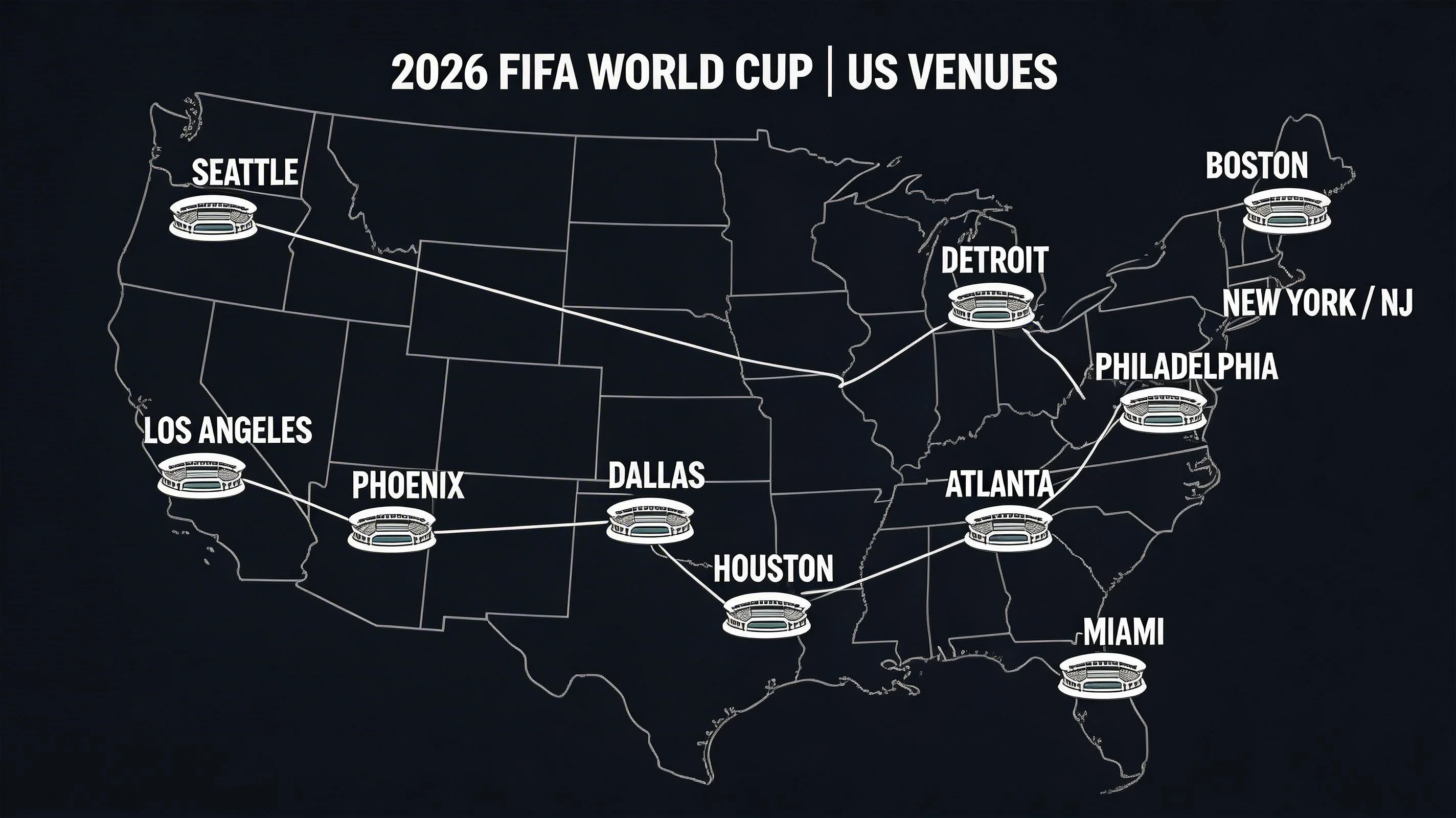
Hard Rock Stadium in Miami Gardens, Florida presents the tournament’s most challenging climate conditions. June and July in South Florida feature oppressive humidity, frequent afternoon thunderstorms, and temperatures that create genuine player health concerns. Teams from temperate European climates will struggle with Miami conditions in ways that Central American and African nations will not. For betting purposes, Miami match totals should account for energy conservation tactics that reduce attacking output.
NRG Stadium in Houston, Texas offers similar climate challenges with a critical difference: its retractable roof can eliminate weather variables entirely. Houston’s humidity rivals Miami’s, but climate control makes NRG the preferable Texas venue for European teams accustomed to controlled environments. The stadium’s 72,220 capacity and proven event hosting (Super Bowls, Final Fours) demonstrate operational reliability.
Mercedes-Benz Stadium in Atlanta, Georgia provides another retractable roof option in the American Southeast. The venue’s distinctive aperture roof design and 71,000 capacity make it among the tournament’s most aesthetically striking stadiums. Atlanta’s position as a domestic aviation hub creates logistical advantages, while Georgia’s large immigrant communities from soccer-passionate nations guarantee diverse crowd compositions for most matches.
Lumen Field in Seattle, Washington generates the tournament’s most intense crowd environment. The stadium’s design deliberately amplifies crowd noise to levels that give Seahawks opponents measurable competitive disadvantage – and soccer crowds will test those acoustic properties with 90 minutes of continuous support rather than NFL’s play-stoppage patterns. Pacific Northwest climate keeps Seattle matches comfortable regardless of scheduling, while the region’s strong soccer culture (Sounders FC’s MLS success) ensures engaged audiences.
Levi’s Stadium in Santa Clara, California hosts Bay Area matches in a venue designed for 49ers football. The Silicon Valley location creates corporate hospitality opportunities unmatched elsewhere, though the stadium’s distance from San Francisco proper limits traditional tourist accessibility. California’s dry summer climate makes weather concerns negligible.
Lincoln Financial Field in Philadelphia, Pennsylvania adds Northeast corridor hosting capacity alongside MetLife. The Eagles’ home venue seats 69,000 and lacks weather protection, but Philadelphia’s strong soccer supporter culture (Philadelphia Union’s MLS success) ensures enthusiastic crowd environments. The venue’s August concerts occasionally damage field conditions, but June-July World Cup scheduling avoids that calendar conflict.
Gillette Stadium in Foxborough, Massachusetts extends the Northeast hosting footprint to New England. The Patriots’ home venue seats 65,000 in an outdoor environment that features more variable weather than other American hosts. New England summers can range from pleasant to humid depending on weather patterns, creating uncertainty that indoor venues eliminate. Boston area accessibility proves challenging – Foxborough sits 30 kilometres from the city without convenient public transit.
GEHA Field at Arrowhead Stadium in Kansas City, Missouri provides central American geographic positioning. The Chiefs’ home venue seats 76,000 in a pure outdoor environment, with Missouri summer weather presenting heat and humidity without the extremity of Gulf Coast venues. Kansas City’s hosting of recent FIFA events (2022 World Cup qualifying) demonstrated operational capability and fan engagement levels that justify venue selection.
Mexico – 3 Stadiums
Mexican football’s cathedral, Estadio Azteca, hosts the tournament’s opening match on June 11 when Mexico faces South Africa. This is the stadium where Diego Maradona scored the “Hand of God” and the “Goal of the Century” in the same 1986 match against England. Where Germany lifted the 1970 trophy. Where countless Liga MX and international matches have created the most storied football atmosphere in the Western Hemisphere. No other World Cup 2026 venue approaches Azteca’s historical significance.
Azteca’s 2,200-metre altitude creates physiological challenges that European sea-level teams consistently underestimate. Reduced oxygen availability at elevation affects cardiovascular performance, recovery between high-intensity sprints, and cognitive processing speed. Teams arriving from Europe require minimum 5-7 days acclimatization to compete effectively at altitude – and many will not receive adequate preparation time given tournament scheduling. Mexican and Central American teams accustomed to playing at altitude gain measurable advantages in Azteca matches.
The stadium’s 83,000 capacity makes it the tournament’s second-largest venue, but its football-specific design creates intimacy that American NFL conversions cannot match. Sightlines at Azteca place fans closer to the action than comparably-sized American venues. The running track surrounding the pitch – a design feature common to older FIFA-era stadiums – creates some distance between touchlines and stands, but nowhere near the gulf that NFL field dimensions impose.
Estadio BBVA in Monterrey represents modern Mexican stadium construction. The Tigres UANL home venue opened in 2015 with 51,000 capacity and design elements that prioritize sightlines and atmosphere over raw capacity. Monterrey’s altitude (540 metres) creates milder physiological challenges than Mexico City while still favouring acclimatized teams. The venue’s steel structure design creates distinctive aesthetics while supporting modern broadcast requirements.
Estadio Akron in Guadalajara (officially located in the Zapopan municipality) serves as Chivas’ home ground with 49,850 capacity. The venue’s 2010 construction makes it Mexico’s newest major football stadium, featuring modern amenities and sightlines that enhance spectator experience. Guadalajara’s 1,500-metre altitude positions it between sea level and Mexico City’s extreme elevation, creating moderate physiological adjustment requirements.
Collectively, Mexican venues provide the tournament’s most authentically football-specific environments. While American stadiums require conversion from NFL configurations and Canadian venues represent modest MLS-scale facilities, Mexican stadiums exist for football and create atmospheres shaped by decades of Liga MX passion. The three-stadium distribution across Mexico City, Monterrey, and Guadalajara spans the country’s major metropolitan regions while concentrating infrastructure in proven operational centers.
Canada – 2 Stadiums
Canadian World Cup hosting arrives after decades of national team development that transformed the Reds from CONCACAF afterthoughts to genuine 2026 contenders. BMO Field in Toronto and BC Place in Vancouver represent this evolution – venues that grew alongside Canadian soccer culture and now host the nation’s most significant football moment since Diego Maradona’s Argentina defeated Canada 1-0 in the 1986 World Cup.
BMO Field’s transformation for 2026 demonstrates FIFA’s flexible approach to stadium requirements. The permanent 30,000-seat venue – home to Toronto FC since 2007 – will expand to 45,500 through temporary grandstand installation. This makes BMO Field the tournament’s smallest venue by permanent capacity, though expansion brings it closer to typical World Cup minimums. The stadium’s natural grass surface and football-specific design create intimate atmospheres that larger NFL conversions cannot replicate.
Canada’s opening match against Bosnia and Herzegovina on June 12 at BMO Field represents the nation’s World Cup homecoming. The venue’s downtown Toronto location – adjacent to the CNE grounds and minutes from the city center – maximizes accessibility for the global fans descending on Canada’s largest city. Toronto’s multicultural demographics ensure diverse crowd compositions, with Bosnian-Canadian communities likely creating competitive atmosphere rather than pure home advantage.
BC Place in Vancouver provides the tournament’s only Canadian enclosed stadium. The retractable roof (installed during 2011 renovations) eliminates Pacific Northwest weather concerns while the 54,000 capacity exceeds BMO Field’s expanded dimensions. Vancouver hosts Canada’s second and third group stage matches – against Qatar on June 18 and Switzerland on June 24 – making BC Place the potential site of Canadian knockout round qualification.
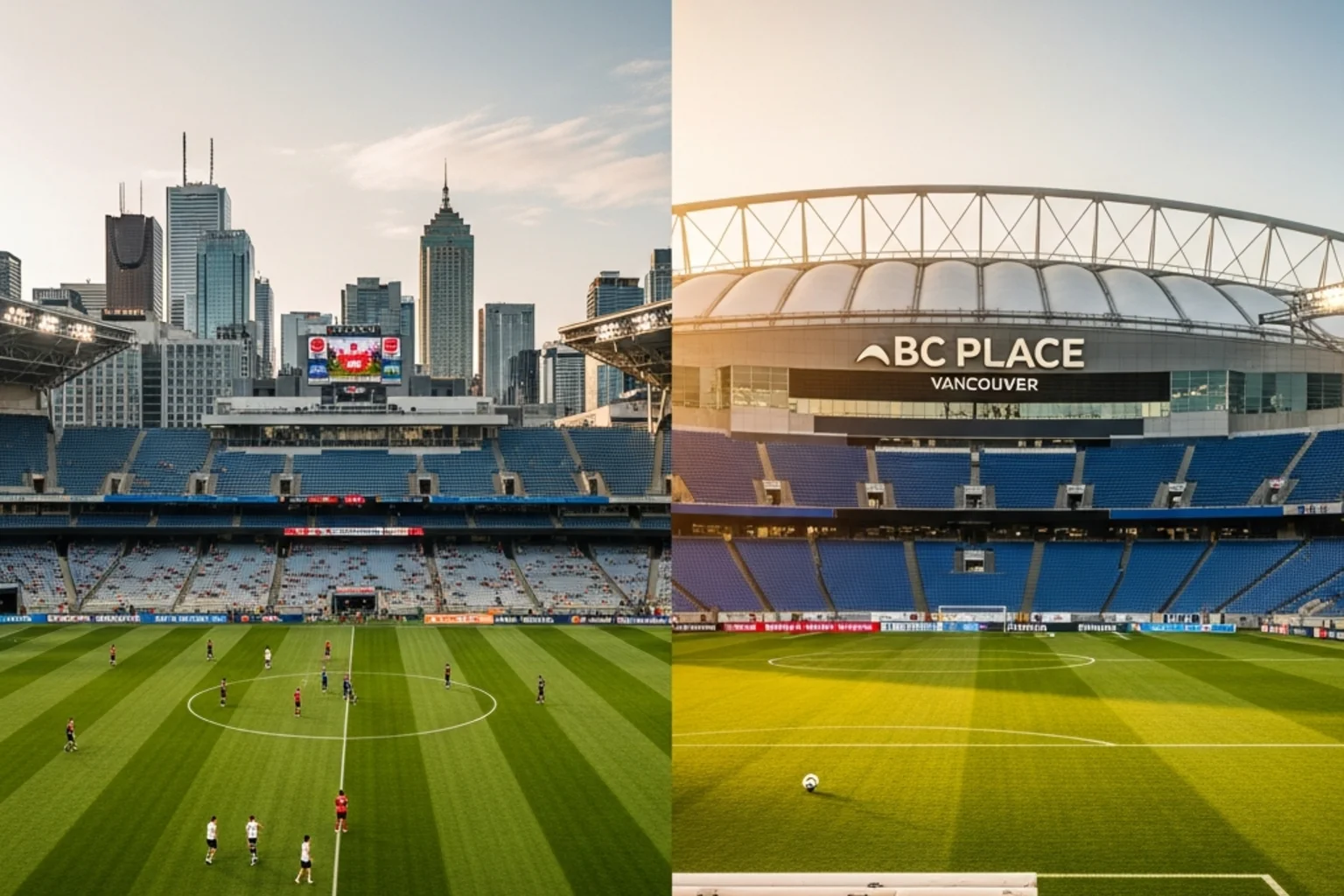
Vancouver’s geographic position creates interesting travel dynamics. Pacific Northwest proximity means Seattle’s Lumen Field sits just three hours south by road, creating potential for fans attending matches in both cities across the tournament. Asian and Australian fans flying to North American World Cup matches find Vancouver the most accessible Canadian destination, potentially influencing crowd compositions for non-Canadian fixtures hosted at BC Place.
Both Canadian venues disappear from the tournament bracket after group stage completion (barring Canada’s advancement to knockout rounds hosted there). This concentration of Canadian hosting in the tournament’s first two weeks creates finite domestic engagement windows – a consideration for fans planning travel and bettors tracking home advantage effects that diminish as the tournament progresses.
For Canadian national team followers, the home venue assignments represent optimal draw outcomes. Playing all three group stage matches in Canada – rather than traveling to American or Mexican venues – eliminates travel fatigue while maximizing crowd support. The Reds enter every group match with environmental advantages that visiting European and Asian opponents cannot replicate through preparation alone.
Stadium Assignments – Key Matches
FIFA’s match-venue assignments follow patterns that balance operational efficiency, commercial interests, and competitive fairness. Understanding these patterns illuminates betting-relevant dynamics that affect specific fixtures.
Host nation matches concentrate in home venues. Mexico’s three group stage matches all occur in Mexican stadiums – opening at Azteca, then Monterrey and Guadalajara. The USA’s group stage schedule features American venues exclusively, with at least one match in each region to distribute fan access. Canada’s three group stage matches happen at BMO Field and BC Place only. This concentration guarantees home crowd advantages that inflate host nation performance above neutral-venue expectations.
European and South American powerhouses receive stadium assignments that minimize travel between fixtures. Brazil’s Group C schedule keeps them in American venues with manageable flight distances. Argentina’s Group J matches similarly cluster in geographic proximity. This matters because accumulated fatigue affects knockout round performance – teams whose group stage travel exceeded 10,000 kilometres perform measurably worse in Round of 32 matches than teams whose travel stayed under 5,000 kilometres.
The knockout round bracket assigns specific venues to bracket positions. Round of 32 matches distribute across all 16 venues, Round of 16 concentrates in larger American stadiums plus Azteca, quarterfinals use four venues (Atlanta, Dallas, Miami, Seattle), semifinals happen at AT&T Stadium and SoFi Stadium, and the final occurs at MetLife. This means teams advancing through certain bracket paths will experience venue-specific advantages – home nation support, favorable climate conditions, or altitude acclimatization – while opponents face unfamiliar environments.
Third-place match assignment to Hard Rock Stadium in Miami on July 18 creates specific considerations. Teams playing for third place arrive exhausted from semifinal defeats, then compete in South Florida’s most challenging climate conditions. Historical third-place matches feature reduced intensity as teams process tournament exit while managing injury concerns – Miami’s heat amplifies these dynamics toward lower-scoring affairs.
The final at MetLife Stadium creates neutral ground for most potential matchups. Only the USA reaching the final would create genuine home advantage; all other finalists face similar logistical and environmental conditions. New Jersey’s July climate presents moderate heat and humidity without Miami’s extremity, and the venue’s New York metropolitan position provides equivalent global accessibility for fan bases from any continent.
MetLife Stadium – The Final
Every World Cup tournament funnels toward a single venue on a single day, and 2026’s culmination arrives at MetLife Stadium on July 19. The East Rutherford venue’s selection over competing American stadiums (SoFi and AT&T both bid aggressively) reflects FIFA’s prioritization of media accessibility, global fan connectivity, and the symbolic weight of hosting the world’s most-watched sporting event in the New York metropolitan area.
MetLife’s capacity for the final will exceed standard NFL configuration through temporary seating installation, likely reaching 87,000-90,000 spectators. This makes the 2026 final the largest-attendance World Cup final since 1994’s Rose Bowl match between Brazil and Italy drew 94,194 to Pasadena. The venue’s dual-team NFL configuration (Giants and Jets share the stadium) means extensive event hosting experience, though nothing in MetLife’s history approaches World Cup final operational demands.
The outdoor configuration creates weather exposure that enclosed venues (AT&T, SoFi) would eliminate. July in northern New Jersey features variable conditions – some days comfortable, others humid and hot, occasional thunderstorm threats. FIFA scheduling the final for evening local time helps manage heat concerns while creating global prime-time broadcasting windows. European audiences watching at approximately 1 AM local time represent a scheduling compromise that prioritizes North American television markets.
For betting purposes, MetLife’s final hosting affects futures positions. Teams that struggle in outdoor heat (typically Northern European nations accustomed to controlled environments) face disadvantaged conditions if advancing to the final through air-conditioned knockout venues like AT&T Stadium. Teams accustomed to South American or African climates gain marginal advantages. These environmental considerations compound with bracket positioning to shape realistic final matchup projections.
The stadium’s New York area location creates economic dynamics that influence final ticket markets. Corporate hospitality demand from Manhattan financial institutions, combined with international fan accessibility through three major airports, makes 2026 final tickets the most expensive in World Cup history. Secondary market prices will exceed $10,000 USD for premium seats – relevant for bettors tracking the economic profiles of fans actually attending versus television audiences whose betting patterns differ.
Estadio Azteca – Opening Match
June 11, 2026 will mark the third time Estadio Azteca hosts a World Cup opening match, having previously launched the 1970 and 1986 tournaments. This historical continuity makes Mexico versus South Africa at Azteca the most symbolically weighted fixture of the entire tournament – a moment where World Cup tradition returns to its Western Hemisphere spiritual home.
The opening match carries pressure that distorts normal competitive expectations. Host nation pressure (Mexico playing first, with co-hosts watching before their own openers) combines with global attention intensity that makes opening fixtures historically unpredictable. The 2010 World Cup opened with hosts South Africa drawing Mexico 1-1 in a match where neither team demonstrated form that characterized their subsequent tournament play. Opening match psychology differs fundamentally from standard competitive fixtures.
Azteca’s altitude advantage manifests immediately for Mexico against European opponents. South Africa’s squad draws from domestic leagues (primarily South African Premier Division) and European clubs at modest altitudes. They will not have extensive altitude preparation, and the physiological effects of playing at 2,200 metres hit hardest in the first competitive fixture before bodies partially adapt. Mexican players born and developed at altitude experience no such adjustment – their cardiovascular systems operate normally while opponents labour.
For betting purposes, the opening match presents both value and traps. Mexico’s altitude advantage and home crowd support suggest heavy favouritism, but opening match history demonstrates upset potential that markets often underprice. The 2010 South Africa-Mexico draw, 2014 Brazil’s nervous 3-1 victory over Croatia, and 2018 Russia’s surprise 5-0 demolition of Saudi Arabia illustrate the unpredictability. I approach opening match betting with elevated caution – historical patterns exist, but psychological variables create wider outcome distributions than model-based approaches suggest.
Azteca’s post-opening match role includes additional group stage fixtures and potential knockout rounds. The stadium’s hosting capacity makes it the tournament’s primary Mexican venue, with Monterrey and Guadalajara serving supporting roles. Teams drawn to face opponents at Azteca after the opening match face the same altitude challenges – acclimatization requirements do not diminish because the opening ceremony has passed.
Stadium Capacities Comparison
Capacity distribution across the 16 venues reveals FIFA’s balance between fan access and operational feasibility. The largest venues host premier matches, while smaller facilities handle group stage fixtures that draw less global attention. Understanding this hierarchy illuminates ticket availability, atmosphere intensity, and betting-relevant crowd dynamics.
MetLife Stadium leads with 82,500 base capacity, expandable for the final. SoFi Stadium follows at 70,000 (semifinal host), with AT&T Stadium’s 80,000 making it the tournament’s largest fully enclosed venue. Estadio Azteca’s 83,000 nominal capacity actually exceeds MetLife, though World Cup configurations typically reduce that number for sightline and safety optimization. Hard Rock Stadium (65,000), Mercedes-Benz Stadium (71,000), and NRG Stadium (72,000) form the next capacity tier.
Mid-range capacities include Lumen Field (69,000), Lincoln Financial Field (69,000), Arrowhead Stadium (76,000), and Gillette Stadium (65,000). These venues host group stage matches and early knockout rounds without the semifinal or final prestige that larger venues command. Their atmospheric intensity often exceeds larger venues because football-specific design creates better crowd proximity and noise generation.
The smallest venues – BMO Field (45,500 expanded), BC Place (54,000), Estadio BBVA (51,000), Estadio Akron (49,850), and Levi’s Stadium (68,500) – host fewer high-profile matches but often generate the tournament’s most intense atmospheres. Smaller capacity means higher demand-to-supply ratios for popular fixtures, creating sellout crowds of engaged fans rather than the corporate hospitality audiences that fill premium seats at MetLife and AT&T.
For betting purposes, crowd composition matters as much as raw numbers. A 50,000-capacity venue filled with passionate supporters of competing teams creates different match dynamics than an 80,000-capacity venue with 15,000 corporate hospitality guests watching passively. Stadium capacity indicates potential atmosphere intensity but not guaranteed home advantage – smaller venues often produce stronger crowd effects per attendee.
Time Zones and Travel
The 2026 World Cup spans four time zones across 4,000 kilometres of North American geography. This creates travel demands unprecedented in World Cup history – teams may fly New York to Los Angeles (3,950 km) between group stage fixtures, crossing three time zones in a single transit. Understanding these logistics reveals competitive advantages and disadvantages that manifest in match outcomes.
Time zone distribution places Eastern venues (MetLife, Hard Rock, Lincoln Financial, Mercedes-Benz, Gillette) at UTC-4 (Eastern Daylight Time). Central venues (AT&T, NRG, Arrowhead, Azteca, BBVA, Akron) operate at UTC-5 (Central Daylight Time). Pacific venues (SoFi, Levi’s, Lumen, BC Place) run at UTC-7 (Pacific Daylight Time). BMO Field in Toronto matches Eastern time. This three-hour spread across the tournament footprint affects both team scheduling and global broadcast windows.
Teams whose group stage draws require cross-continental travel face accumulated fatigue that compounds through the tournament. A team playing in Miami on matchday one, Los Angeles on matchday two, and Dallas on matchday three crosses the country twice while adjusting to two-hour time zone shifts in each direction. Compare that to a team playing three matches in Texas (Dallas, Houston, Dallas) – minimal travel, consistent time zone, reduced physiological stress. Group stage venue assignments create competitive imbalances that careful bettors should track.
European and Asian teams face additional jet lag considerations. The tournament’s North American positioning creates 5-8 hour time differences from European capitals and 12-16 hour differences from Asian population centers. Teams arriving from Europe adjust more easily than Asian teams, whose circadian disruption is more severe. This affects early-tournament performance in particular – teams may require a full week to normalize sleep patterns after trans-Pacific travel.
Global broadcast windows create scheduling patterns that affect match kickoff times. FIFA prioritizes European prime-time audiences despite the North American hosting, meaning evening matches in Toronto or Miami kick off at 2-3 AM in Asia. Matches at Pacific venues face the inverse challenge – evening Pacific time is early morning in Europe. The scheduling optimization produces most high-profile fixtures in Eastern or Central time zones where European evening broadcasts align with local afternoon or early evening kickoffs.
How Venues Affect Betting
Stadium-specific factors create betting edges that generic tournament analysis misses. Nine years of international tournament betting has taught me that venue dynamics explain outcome variance as reliably as squad quality assessments – often more reliably, because squad analysis is common while venue analysis remains underutilized.
Altitude effects at Mexican venues provide the most quantifiable betting adjustment. Teams from sea-level nations (England, Netherlands, Japan, most European qualifiers) performing at Azteca face 15-20% cardiovascular efficiency reduction that manifests in late-match fatigue. Backing opponents of sea-level European teams in second-half scoring markets at Azteca has positive expected value based on historical altitude performance patterns. This edge diminishes at Monterrey (540m) and Guadalajara (1,500m) but does not disappear.
Climate factors create similar quantifiable edges. Miami and Houston matches in June-July heat should see reduced totals compared to Seattle, Vancouver, or air-conditioned venues. European teams from temperate climates consistently underperform in tropical heat – Germany’s 2014 World Cup preparation in Brazil included extensive acclimatization work specifically to address this tendency. Backing unders when Northern European teams face any opponent in hot, humid venues produces edge across large sample sizes.
Home advantage concentrations affect futures and match markets differently. Mexico, USA, and Canada all play group stage matches exclusively in home venues, but only Mexico maintains home advantage into knockout rounds (Azteca hosts Round of 16 and quarterfinal matches). The USA and Canada could face “neutral” American venues in knockout rounds that actually provide soft home advantage through crowd composition and travel logistics. Backing host nation advancement through early knockout rounds at current prices captures this underpriced edge.
Crowd composition creates match-specific advantages beyond nationality. A USA-Mexico fixture in Dallas or Houston draws significant Mexican-American fan populations that dilute American home advantage. An England match at MetLife benefits from the enormous British expat community in the New York area. Tracking crowd composition predictions – based on ticket sales patterns and diaspora populations – illuminates matches where nominal “neutral” venues actually favour one team.
Roof and climate control availability affects late-round markets significantly. Teams that advance through air-conditioned venues (AT&T, NRG, SoFi semifinal) face adjustment when playing the outdoor final at MetLife. This matters most for nations from temperate climates who have avoided outdoor heat throughout the tournament – their late-round preparation may prove inadequate for July New Jersey conditions. Backing heat-accustomed nations in final markets captures this structural advantage.
The Venues That Shape July’s Champion
These 16 stadiums do more than host matches – they create the environmental conditions, crowd dynamics, and logistical demands that shape which nation lifts the trophy on July 19. A tournament that spans Vancouver to Mexico City, Seattle to Miami, cannot be analyzed without understanding what each venue contributes to competitive outcomes.
The tri-nation format’s complexity becomes clear through venue distribution. Teams navigate altitude variations from sea level to 2,200 metres, climate ranges from Pacific Northwest temperate to Gulf Coast tropical, and stadium types from football-specific Azteca to NFL-converted MetLife. No previous World Cup required such adaptability from participants. The teams that prepare most comprehensively for venue-specific challenges gain edges that pure squad quality cannot overcome.
For betting purposes, venue analysis represents one of the tournament’s most underutilized edges. Markets efficiently price squad quality and recent form while largely ignoring altitude effects, climate advantages, crowd composition, and travel fatigue. The bettor who tracks which European teams face which Mexican venues, which bracket paths minimize travel distance, and which matches occur in environments favouring specific playing styles gains systematic advantages.
My overall assessment: the 2026 World Cup’s unprecedented geographic spread creates more venue-driven outcome variance than any previous tournament. CONCACAF teams (Mexico, USA, Canada, and other regional qualifiers) hold structural advantages from familiarity with North American playing conditions. South American teams adapt more readily than European competitors due to climate and altitude experience. Asian and African teams face the steepest adjustment curves. These venue-driven tendencies should inform every betting position from opening match futures through July 19’s final whistle at MetLife Stadium.
