

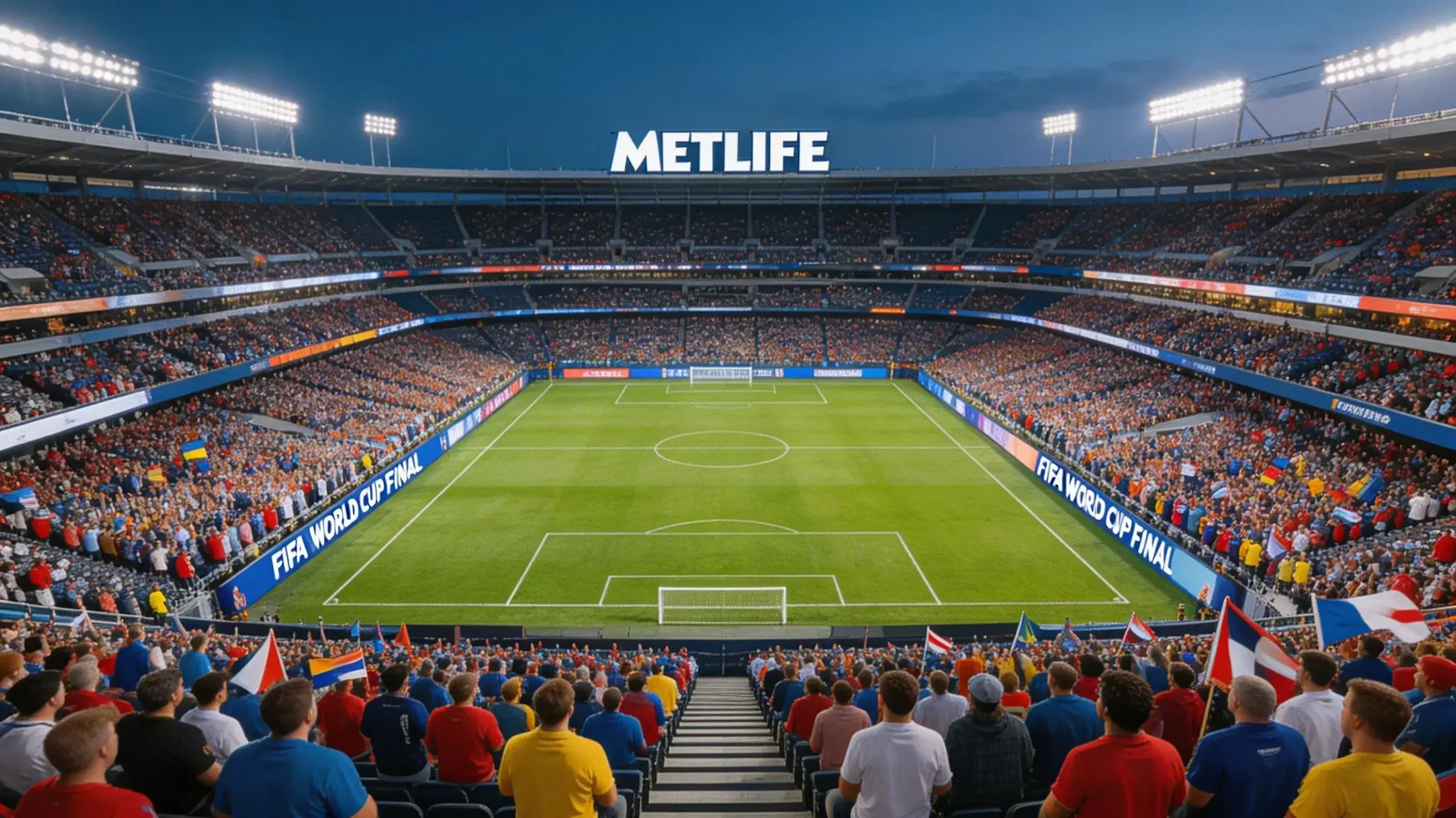
Every World Cup final requires a stage worthy of football’s ultimate moment – a venue where history will unfold before millions watching globally and tens of thousands witnessing in person. On July 19, 2026, MetLife Stadium in East Rutherford, New Jersey assumes that role, hosting the final match of the most ambitious World Cup ever attempted. The choice was controversial, the venue imperfect, but the commercial logic undeniable.
FIFA’s decision to award the final to the New York metropolitan area prioritized global commercial appeal over atmospheric considerations. MetLife Stadium lacks the iconic status of a Maracanã or Wembley, the architectural drama of a Bird’s Nest or Allianz Arena. What it offers instead is capacity, infrastructure, and proximity to the world’s most influential media market. These trade-offs define the 2026 World Cup – scale over intimacy, reach over tradition.
MetLife Stadium Overview
MetLife Stadium opened in 2010 as the shared home of the New York Giants and New York Jets, replacing the aging Giants Stadium that had occupied the same Meadowlands sports complex since 1976. The $1.6 billion construction cost made it among the most expensive sports facilities ever built, with design priorities centred on NFL revenue generation rather than football (soccer) atmosphere.
The open-air bowl configuration differs fundamentally from European football stadium designs. NFL requirements prioritize wide concourse access for commercial activity during games, creating gaps in the seating structure that diminish the intimate bowls European supporters expect. The rectangular footprint accommodates American football’s end zones, requiring adjustment for the narrower football pitch dimensions that place supporters further from sideline action than purpose-built venues.
Capacity reaches approximately 82,500 for World Cup configuration – the largest of any 2026 venue and appropriate for the final’s commercial requirements. The scale ensures ticket availability for the massive demand that finals generate while maximizing FIFA’s revenue from their showcase event. The trade-off, predictably, is atmosphere dilution that makes intimate venues feel electric while mega-stadiums feel merely full.
The Meadowlands location places MetLife Stadium outside any urban centre. East Rutherford, New Jersey offers highway access and parking infrastructure that downtown venues cannot provide, but the surrounding industrial landscape lacks the walkable entertainment districts that give European match days their character. Supporters arrive by car or dedicated transit, watch the match, and leave – the stadium functions as destination rather than neighbourhood anchor.
Weather exposure creates uncertainty that FIFA cannot control. July in the New York area brings humidity, heat, and the possibility of thunderstorms that could delay matches. The open-air design means players and supporters experience whatever conditions nature delivers – potentially problematic for evening finals that coincide with summer storm systems common to the region.
Hosting the World Cup Final
The final on July 19, 2026 represents the culmination of 104 matches across 39 days, determining the world champion before a global audience exceeding one billion viewers. MetLife Stadium will host the defining moment of football’s quadrennial cycle – a responsibility that carries both pressure and prestige.
FIFA’s choice of the New York area reflected commercial prioritization that critics found disappointing but unsurprising. The New York media market offers unparalleled sponsorship activation opportunities, while proximity to FIFA’s North American commercial partners simplifies logistics for corporate hospitality. The final’s 4:00 PM Eastern kickoff creates primetime viewing in Europe while maintaining afternoon accessibility for American audiences – a broadcast calculation that drove timing decisions.
For teams reaching the final, MetLife Stadium provides genuinely neutral ground. Neither USA nor Mexico nor Canada can claim home advantage in the Giants’ and Jets’ shared facility, creating competitive balance that controversial host-nation finals sometimes lack. The stadium’s NFL-focused design means no participating nation has meaningful experience with the venue – everyone arrives equally unfamiliar with the pitch, sightlines, and atmosphere.
The betting markets for the World Cup final will be the most liquid of any football match in history. Global wagering volumes exceed anything regular season or even Champions League finals generate, creating opportunities for those who have tracked tournament developments more closely than casual final-day bettors. Line movement in the 48 hours before kickoff reveals sharp money flows that can guide last-minute positioning.
Historical patterns suggest backing teams that arrive at finals through momentum rather than grinding attrition. The expanded 48-team format means seven matches to reach the final – a physical and emotional toll that favours squad depth and rotation capability. Teams relying on core players for every knockout match accumulate fatigue that manifests in final-match underperformance, while those with trusted bench options maintain freshness that translates to better execution under pressure.
All World Cup Matches at MetLife
Beyond the final, MetLife Stadium hosts group stage matches and knockout fixtures throughout the tournament – its capacity makes it essential for FIFA’s commercial model at every stage. The venue’s schedule includes some of the tournament’s most anticipated group matchups, selected to maximize attendance and broadcast value.
Group stage assignments favour teams with substantial supporter communities in the New York metropolitan area. The region’s massive Latino population means matches involving Mexico, Colombia, Ecuador, and other Latin American nations effectively become home fixtures. Argentina, defending champions with passionate supporters throughout the tri-state area, will likely play before crowds dominated by their fans regardless of opponent.
The round of 32 and round of 16 bring MetLife Stadium into knockout action, where single-elimination stakes intensify atmosphere beyond group stage levels. These matches occur earlier in July, before the semifinal and final dates, creating a rhythm where MetLife hosts repeatedly throughout the tournament’s middle weeks.
Quarterfinal and semifinal assignments distribute across multiple American venues, but MetLife’s schedule ensures consistent action through the tournament’s duration. The venue’s commercial importance to FIFA’s financial model requires maximizing events – empty dates at the largest stadium represent significant revenue foregone.
Capacity and Configuration
The 82,500 capacity for World Cup 2026 represents MetLife Stadium’s maximum football configuration, with temporary seating additions in end zones extending beyond the permanent structure. This capacity exceeds any other tournament venue, ensuring the final and other premium matches accommodate demand that smaller facilities cannot absorb.
The seating bowl’s NFL-optimized design creates challenges for football atmosphere. American football’s sporadic action – punctuated by commercial breaks and extended stoppages – suits wide concourses where fans socialize between plays. Football’s continuous 45-minute halves demand engaged attention that benefits from tight sight lines and minimal distraction zones. MetLife’s design compromises football-specific atmosphere for the multi-sport flexibility that NFL investment priorities require.
The comparison across all 16 World Cup venues reveals MetLife’s capacity advantage while highlighting atmospheric trade-offs. Smaller venues like BMO Field or Estadio BBVA create intimate pressure that MetLife’s scale cannot replicate, even with higher absolute attendance. The final’s prestige may overcome these structural limitations – supporters in the stadium for a World Cup final bring intensity regardless of architectural shortcomings.
Sight line quality varies significantly by section. Lower bowl seats provide excellent proximity but limited elevation, making tactical pattern recognition difficult. Upper deck sections offer strategic overviews but remove supporters from the physical presence of players. Premium club level seating balances these considerations while adding hospitality amenities that FIFA’s corporate partners demand. Ticket pricing reflects these distinctions, with final seats ranging from hundreds to thousands of dollars based on section location.
The playing surface receives intense preparation before World Cup fixtures. MetLife’s natural grass field serves NFL tenants September through January, then undergoes maintenance and preparation cycles during the offseason. World Cup timing – June through mid-July – allows optimal grass growth conditions, though New Jersey heat and humidity stress turf in ways that cooler climates avoid. Grounds crews will implement intensive maintenance protocols to ensure FIFA-standard surface quality for every match.
Location – East Rutherford, New Jersey
The Meadowlands Sports Complex occupies marshland in Bergen County, New Jersey, approximately 13 kilometers west of Midtown Manhattan. This suburban location provides highway access and parking capacity that urban sites cannot offer while creating logistical challenges for supporters accustomed to walkable European match day experiences.
Public transit to MetLife Stadium requires planning that spontaneous attendance does not accommodate. New Jersey Transit provides rail service to Secaucus Junction, with dedicated bus connections to the stadium on event days. The journey from Penn Station takes approximately 45 minutes including transfer time – manageable but not convenient. The PATH train from Manhattan does not directly serve the stadium, requiring additional connections that extend travel time further.
Driving remains the primary access mode for local supporters, though World Cup volumes will overwhelm parking facilities designed for NFL crowds. The surrounding highway network – Routes 3, 17, and 120 plus the New Jersey Turnpike – provides multiple approach vectors, but tournament-day traffic management will create delays regardless of route selection. Plan arrival hours before kickoff for critical matches.
Accommodation options in East Rutherford itself are limited – the area lacks hotels at tournament-demand scale. Supporters staying in Manhattan face the transit logistics described above, while those based in New Jersey suburbs may find closer options in towns like Paramus or Hackensack. The limited walkable entertainment near the stadium means supporters cannot replicate the pub-to-ground experience that characterizes European match days.
Stadium History and Events
MetLife Stadium’s history spans barely 15 years, making it one of the newer venues in the World Cup rotation despite its size. The facility replaced Giants Stadium, which hosted matches during the 1994 World Cup that planted seeds for American football culture’s subsequent growth. The connection to that tournament – the last World Cup held in the United States – creates historical resonance that 2026 organizers emphasize in promotional materials.
Beyond NFL games, MetLife Stadium has hosted major events including WrestleMania, international friendlies, and concerts that test the venue’s multi-purpose capabilities. The 2016 Copa America Centenario final between Argentina and Chile demonstrated the stadium’s football hosting potential, though that match occurred before crowds that did not test maximum capacity.
The Super Bowl XLVIII in February 2014 remains the only Super Bowl hosted in a cold-weather outdoor stadium, a logistical experiment that produced playable but uncomfortable conditions. That experience informed infrastructure investments in weather preparation that World Cup organizers will benefit from, though July conditions present opposite challenges to February cold.
For New York area football supporters, MetLife Stadium represents the primary venue for international friendlies and special events that bring global clubs and national teams to the region. Manchester United, Real Madrid, Barcelona, and other elite clubs have played at MetLife during summer tours, creating familiarity that domestic fans carry into World Cup attendance. These events also revealed the venue’s football-specific limitations – the vast distances from pitch to stands, the acoustic challenges of the open design, the NFL-centric concessions and sight lines.
July 19, 2026 will become the defining date in MetLife Stadium’s history regardless of its subsequent use. Hosting a World Cup final cements venue legacy in ways that regular season NFL games or occasional concerts cannot match. Whatever team lifts the trophy that evening, MetLife Stadium becomes permanently associated with that moment – a place where world champions were crowned before 82,500 witnesses and billions more watching globally.
