

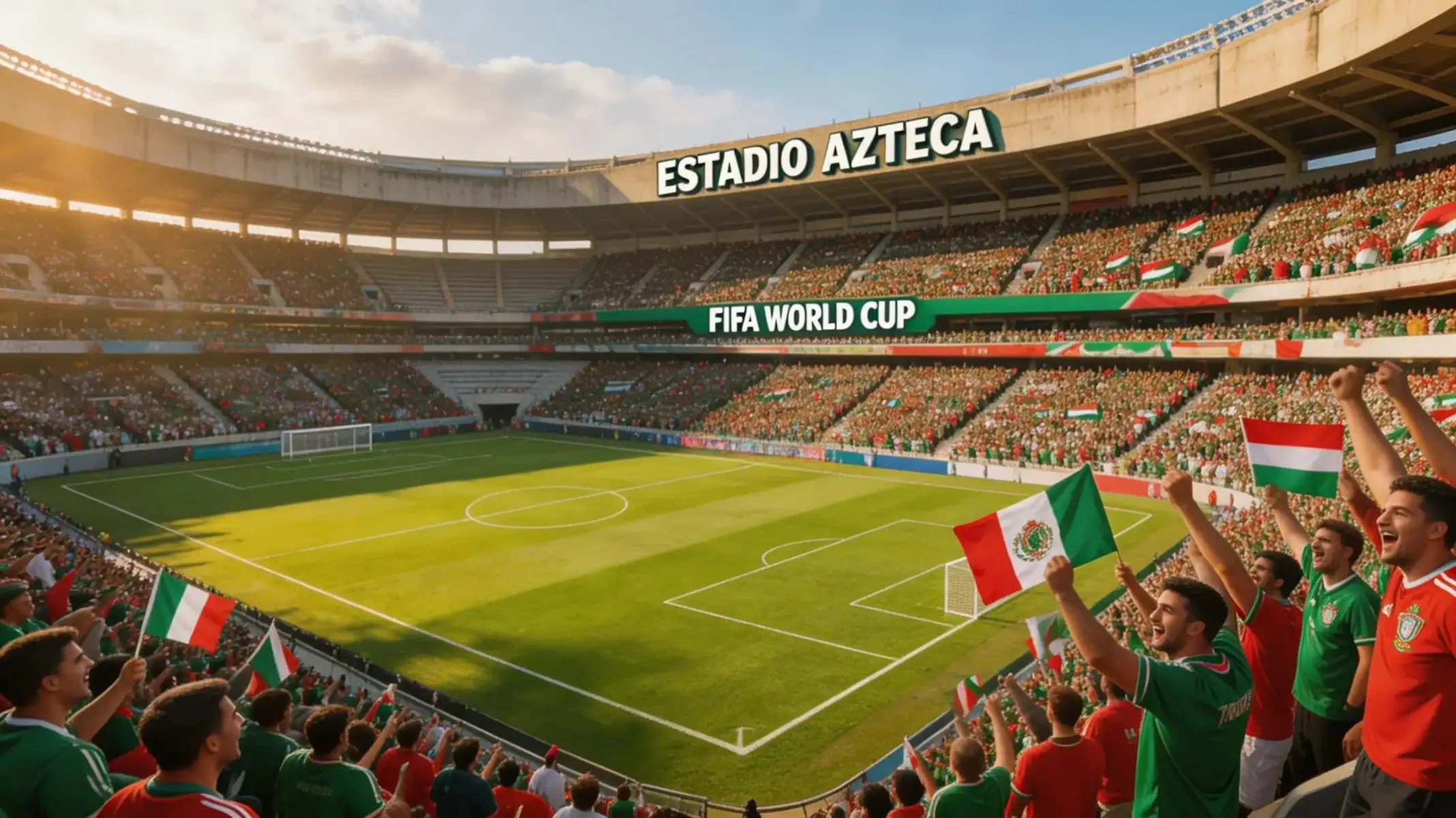
The Hand of God happened here. Pelé’s third World Cup triumph happened here. When Diego Maradona beat five English defenders before slotting past Peter Shilton in the 1986 quarterfinal, the Estadio Azteca bore witness to perhaps football’s greatest individual moment. No stadium on Earth carries more World Cup history than this concrete cathedral in Mexico City’s Coyoacán borough – and on June 11, 2026, Azteca becomes the first venue to host matches in three different World Cups.
The opening match of the expanded 48-team tournament takes place where football history runs deepest. Mexico versus South Africa kicks off the 2026 World Cup in a stadium that has already hosted two finals, countless semifinals, and decades of Liga MX passion. FIFA’s choice to begin here acknowledges what no American stadium can claim – Azteca is sacred ground for the beautiful game.
Estadio Azteca Overview
Built for the 1968 Summer Olympics and opened in May 1966, Estadio Azteca has served as Mexico’s national stadium for nearly six decades. The original capacity approached 120,000 – enough to dwarf any modern venue – though current FIFA configurations reduce that to approximately 87,500 for World Cup matches. Even at reduced capacity, Azteca remains among the largest football stadiums on the planet.
The architectural design reflects mid-century modernism with brutalist concrete construction that has weathered decades while maintaining structural integrity. The distinctive spiral ramps leading to upper levels create an ascent that builds anticipation – rising through the structure, supporters sense the scale that awaits before seeing the pitch. When that first glimpse arrives, the bowl’s enormity delivers what the approach promised.
Club América of Liga MX claims Azteca as home ground, while Cruz Azul shared the venue until relocating in 2023. The Mexican national team plays virtually all significant home fixtures here, creating a competitive advantage that visiting teams genuinely fear. Mexico’s World Cup qualifying record at Azteca approaches perfection – the combination of hostile crowd, challenging altitude, and national team quality makes this among the most difficult away fixtures in global football.
The stadium’s location in southern Mexico City places it approximately 12 kilometers from the historic Zócalo city centre. Urban development has surrounded Azteca with residential neighbourhoods that transform match days into community festivals, with local vendors and supporters creating atmospheres that begin hours before kickoff and extend well into post-match celebrations.
First Stadium to Host Three World Cups
When Mexico hosts South Africa on June 11, 2026, Estadio Azteca achieves a distinction no other stadium has matched. The venue has already hosted two World Cup finals – Brazil’s 4-1 victory over Italy in 1970 and Argentina’s 3-2 win over West Germany in 1986 – plus countless other tournament matches across those events. Adding a third World Cup to this résumé cements Azteca’s claim as football’s most historically significant venue.
The 1970 World Cup marked the tournament’s first colour television broadcasts, with Azteca’s matches beaming Pelé, Jairzinho, and the greatest Brazilian team ever assembled into living rooms worldwide. That tournament’s final remains a reference point for attacking football – Brazil dismantled a strong Italian side with passing combinations that contemporary coaches still study.
Sixteen years later, Diego Maradona dominated the 1986 World Cup with individual brilliance that peaked in the Azteca quarterfinal against England. His “Goal of the Century” – the dribble that beat half the English team – occurred here, minutes after the controversial “Hand of God” goal that remains debated decades later. The final victory over West Germany secured Argentina’s second World Cup title and Maradona’s legacy as his generation’s greatest player.
Beyond finals, Azteca has hosted semifinals, quarterfinals, and group stage matches across both tournaments. Players from dozens of nations have experienced the unique demands of performing at altitude before hostile Mexican crowds. This accumulated history creates an atmosphere that modern stadiums simply cannot replicate – the weight of decades hangs in Azteca’s air alongside the thin oxygen.
Opening Match – Mexico versus South Africa
FIFA’s decision to begin the 2026 World Cup at Azteca honored tradition while creating a marquee event that justifies global attention. The opening match on June 11 pits host nation Mexico against South Africa in Group A – a fixture that carries weight beyond its competitive implications.
Mexico entering a home World Cup creates expectations that can either inspire or crush. El Tri have never advanced past the quarterfinals in their World Cup history – the famous “quinto partido” (fifth match) barrier that has frustrated Mexican football for generations. Playing the tournament’s first match at home, before 87,000 supporters at Azteca, establishes early whether this generation can handle the pressure that comes with host nation status.
South Africa faces one of world football’s most hostile environments for their opener. The altitude alone – 2,240 metres above sea level – creates physiological challenges that European and coastal African teams rarely encounter. Add 87,000 Mexican supporters creating noise that physically affects concentration, and South Africa’s task becomes daunting regardless of tactical preparation.
For betting purposes, the opening match heavily favours Mexico through factors that odds may not fully capture. Home advantage at Azteca transcends normal calculations – Mexico’s combination of acclimatized players, passionate support, and altitude adaptation creates edges worth several goals over neutral conditions. The market will price Mexico as favourites, but the true implied probability may exceed what lines suggest. Back Mexico on the match result and consider first-half spreads that exploit Mexico’s historically strong starts at Azteca.
The opening ceremony preceding kickoff adds emotional weight that affects player psychology in unpredictable ways. Some players rise to ceremonial occasions while others find the extended pre-match period disruptive. Mexico’s players have experienced Azteca atmospheres throughout their careers; South Africa’s squad may find the sensory overload difficult to process before competitive action begins.
All World Cup Matches at Estadio Azteca
Beyond the opening fixture, Azteca hosts additional group stage matches that take advantage of the venue’s capacity and historical significance. FIFA’s scheduling prioritizes matches involving nations with substantial supporter communities in Mexico and the southwestern United States – proximity to the border creates access that Central and South American teams’ supporters will exploit.
Group A matches beyond Mexico versus South Africa include fixtures among South Korea, Czechia, and the other group participants. The venue’s capacity ensures ticket availability for matches that might not fill smaller stadiums, while the historic setting provides appropriate stages for every fixture regardless of competitive significance.
Knockout round hosting extends through at least the round of 32, giving Mexican supporters opportunities to see their team on home soil beyond group play. Should Mexico advance as expected, Azteca could host El Tri for a fourth match – though this depends on bracket positioning that emerges from group stage results.
The distribution across all 16 World Cup venues ensures Azteca receives appropriate fixture allocation without monopolizing significant matches. Later knockout rounds shift to American venues with larger capacities and more neutral access, though Azteca’s group stage hosting ensures the tournament’s most historically significant stadium plays a prominent role.
Iconic World Cup Moments at Azteca
Cataloging Azteca’s World Cup moments requires acknowledging that some of football’s defining images occurred on this pitch. The stadium has witnessed triumph and controversy, individual brilliance and collective excellence, in measures that no other venue can match.
Pelé’s final World Cup goal came at Azteca – the diving header against Italy in the 1970 final that extended Brazil’s lead and confirmed the tournament’s greatest performance. That Brazilian team scored 19 goals in six matches, with the final’s artistry serving as capstone to an attacking display that remains unmatched in World Cup history.
Maradona’s 1986 performance against England combined the controversial and the sublime in ways that defined both player and tournament. The “Hand of God” goal – a punch past goalkeeper Shilton that referees missed – preceded within minutes by the “Goal of the Century” that required no controversy. That dribble past Terry Butcher, Peter Reid, Terry Fenwick, and finally Shilton demonstrated individual brilliance that subsequent decades have not diminished.
Beyond individual moments, Azteca has hosted systemic football excellence. The Dutch “Total Football” of 1974 found expression in later tournaments here; the defensive organization of Italian catenaccio collapsed against attacking fury in 1970. Tactical innovations, strategic evolutions, and footballing philosophies have all been tested at Azteca’s altitude, with the venue serving as laboratory for the sport’s ongoing development.
The 2026 World Cup adds new chapters to this history. Some of those chapters are already written – Mexico’s opening match, the group stage fixtures, the early knockout rounds. Others await the tournament’s competitive reality to determine which moments will be remembered alongside Pelé’s header and Maradona’s dribble. Whatever emerges, Azteca provides the stage that history deserves.
Location in Mexico City
Mexico City’s Coyoacán delegation hosts Estadio Azteca in the metropolitan area’s southern reaches. The urban sprawl that characterizes the world’s fifth-largest city surrounds the venue, creating access challenges that require planning regardless of transportation mode.
The Mexico City Metro provides the most reliable match-day access. Line 2 terminates at the Estadio Azteca station, with service from the Zócalo historic centre taking approximately 35 minutes. The metro’s affordability and frequency make it the preferred option for local supporters, though World Cup volumes will test system capacity beyond typical Liga MX match demands.
Driving to Azteca during match events requires patience that most visitors underestimate. The Periférico ring road provides vehicle access, but the stadium’s neighborhood streets become impassable as kickoff approaches. Parking availability is limited, and the combination of match-day closures and normal Mexico City traffic creates delays measured in hours rather than minutes. Plan alternative transportation or accept significant schedule uncertainty.
Accommodation in the Coyoacán area includes boutique hotels and Airbnb options that offer proximity at the cost of urban convenience. Downtown Mexico City hotels – in the Roma, Condesa, or Polanco neighborhoods – provide better dining and entertainment access while requiring metro journeys to match venues. The 2026 World Cup will strain lodging capacity regardless of location choice, making early reservation essential for anyone planning attendance.
Altitude acclimatization for visiting supporters deserves consideration beyond match-day logistics. Mexico City sits 2,240 metres above sea level – high enough to affect physical exertion and alcohol tolerance for coastal arrivals. Plan several days of adjustment before active exploration, and moderate consumption to avoid altitude-intensified effects.
The match-day atmosphere extends well beyond the stadium boundaries. Neighborhoods surrounding Azteca transform into street festivals on significant match days, with food vendors, supporters’ gatherings, and spontaneous celebrations creating experiences that the stadium itself only partially captures. Arriving early allows participation in these periphery activities while ensuring entry before kickoff – the opening match will not accommodate late arrivals.
