

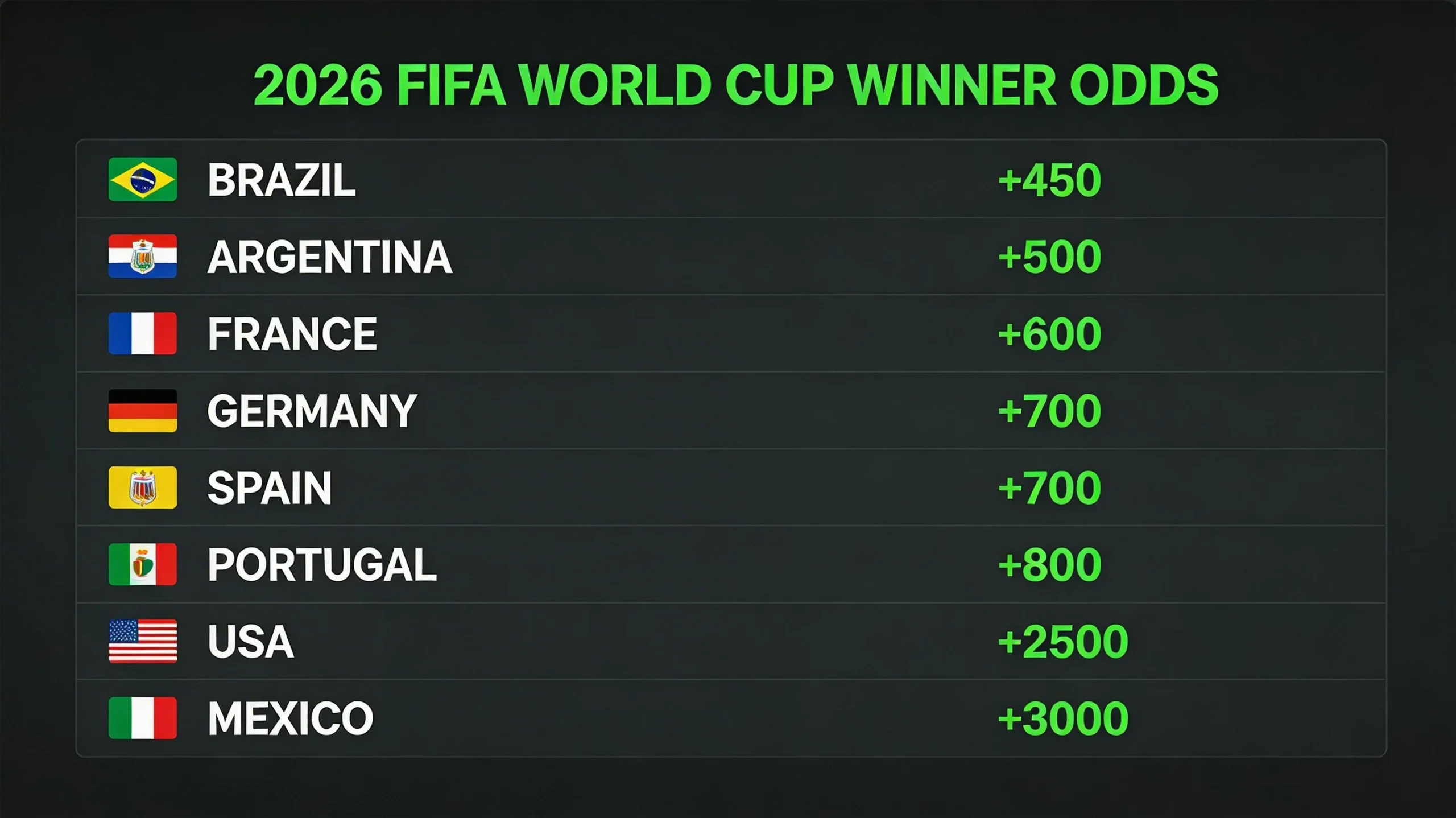
The odds board tells a story that transcends raw numbers. When I pulled up World Cup 2026 futures this morning, the same narrative emerged that has dominated tournament betting for six months: Europe versus South America, youth versus experience, and one question nobody can definitively answer – does hosting actually matter when the host is three different countries spanning four time zones?
World Cup 2026 odds have crystallized around six legitimate contenders separated by 400 points of implied probability, followed by a chasing pack of dark horses and longshots whose prices reflect dreams more than realistic expectation. The expanded 48-team format creates opportunities invisible in previous tournaments. Twelve groups mean twelve potential group winner bets. Thirty-two knockout round berths mean thirty-two paths to a semifinal surprise. And the sheer volume of 104 matches produces inefficiencies that sharper bettors will exploit while recreational money chases obvious plays.
This page tracks current World Cup 2026 odds across major markets, analyzes pricing tiers to identify value, and provides the context necessary for intelligent futures betting. For those new to tournament wagering, our complete World Cup betting guide covers fundamentals before diving into specific odds. Odds shift daily based on injury news, qualification results, and market action. What you see here represents a snapshot – but the analytical framework applies regardless of how prices move between now and June 11, 2026.
World Cup 2026 Outright Winner Odds
Every four years, I watch casual bettors lock in tournament winner futures without understanding what they are actually buying. They see Brazil at +500 and think “five times my money if Brazil wins.” They do not consider that +500 implies roughly 17% probability, that their capital stays locked for months or years, and that Brazil must win seven consecutive matches against increasingly desperate opponents to deliver that payout. Outright winner betting demands longer time horizons and different expectations than match-level wagering.
Argentina enters 2026 as defending champions and consensus betting favourites. Most books price Lionel Scaloni’s side between +400 and +450, implying 18-20% probability of back-to-back World Cup titles. The last team to repeat was Brazil in 1958-1962. History suggests repetition is extraordinarily difficult – but Argentina possesses perhaps the most complete squad in international football, combining Lionel Messi’s genius (yes, he will be 38 and playing in MLS, but genius does not expire) with a supporting cast that won the 2021 Copa America, 2022 World Cup, and 2024 Copa America in succession.
France occupies the second tier at +500 to +550. Kylian Mbappe leads a generation of French talent that finished second in 2022, and the squad’s depth at every position matches or exceeds Argentina’s. The French path to the final depends heavily on bracket luck – their traditional knockout round struggles against tactical underdogs (Portugal 2016, Switzerland 2021) suggest vulnerability that does not fully reflect in their odds.
England sits at +550 to +650 across major books. The Three Lions have reached three consecutive tournament semifinals (2018 World Cup, Euro 2020, Euro 2024) without claiming a trophy. Jude Bellingham’s emergence as a global superstar provides the creative fulcrum England have historically lacked, while the core of Harry Kane, Phil Foden, and Bukayo Saka offers proven international pedigree. The question is psychological: can England finally convert semifinal presence into tournament victory?
Brazil rounds out the elite tier at +550 to +650 despite entering 2026 amid their longest World Cup drought since 1950. Twenty-four years without lifting the trophy weighs heavily on Brazilian football, and recent coaching instability (three managers since 2022) creates uncertainty about tactical identity. Yet the raw talent – Vinicius Jr., Rodrygo, Endrick – suggests upside that odds do not fully capture. Brazil represents the classic high-variance futures play: lower floor than Argentina or France, higher ceiling than their odds imply.
Germany and Spain complete the top six at +800 to +1000. Germany’s post-Euro 2024 rebuild under new management has restored competitiveness, though winning the tournament requires overcoming historical knockout round fragility. Spain’s Euro 2024 triumph announced a generational transition led by Lamine Yamal, still a teenager when the 2026 World Cup begins, alongside Pedri and Gavi forming perhaps the most talented young midfield in world football.
Portugal at +1200 to +1500 represents the final realistic contender tier. Cristiano Ronaldo’s potential involvement creates narrative intrigue, but Portugal’s squad depth beyond their starting XI raises questions about their seven-match stamina. The rest of the market – Netherlands, Belgium, Italy (did not qualify), and various emerging football nations – prices at +2000 or longer, reflecting outsider status rather than genuine championship probability.
Odds Breakdown by Tier
Sportsbooks price World Cup futures through probability buckets that reveal their assessment of realistic outcomes. When you understand tier structure, you can identify mispricings where market consensus diverges from your own analysis.
Elite Favourites – +300 to +600
The elite tier contains teams bookmakers consider genuine tournament favourites – those with realistic 15-25% probability of lifting the trophy. In 2026, this tier includes Argentina (+400-450), France (+500-550), England (+550-650), and Brazil (+550-650). Combined implied probability for this group: approximately 70%, meaning bookmakers believe there is a 70% chance one of these four teams wins the World Cup.
Historical validation supports this pricing structure. Since 1998, 75% of World Cup winners came from the pre-tournament top-four in odds (France 1998, Brazil 2002, Italy 2006, Spain 2010, Germany 2014, France 2018, Argentina 2022). The exception – Italy 2006 – entered the tournament dealing with the Calciopoli match-fixing scandal and was underpriced relative to their actual quality.
Value in the elite tier requires contrarian thinking. You are not betting on whether these teams can win – obviously they can. You are betting on whether the implied probability accurately reflects their chances relative to each other and to the chasing pack. If you believe Argentina has 25% probability but the market prices them at 18% (+450), positive expected value exists. If you believe they have 15% probability, the same +450 represents negative expected value.
Serious Contenders – +700 to +1500
Contender-tier teams possess the squad quality to reach semifinals and the tactical discipline to potentially upset elite opponents over 120 minutes. Germany (+800), Spain (+900), Portugal (+1200), Netherlands (+1400), and Belgium (+1500) populate this tier for 2026.
The contender tier historically produces one semifinalist per World Cup. Sometimes that semifinalist wins the tournament outright – Germany in 2014 entered as third or fourth favourite depending on the book. More often, contender-tier teams exceed expectations in the group stage, produce one memorable knockout upset, then fall to elite opposition in the quarterfinals or semifinals. Croatia’s runs to the 2018 final and 2022 semifinal exemplify maximum contender-tier performance.
Betting contenders requires patience and hedging strategy. A pre-tournament bet on Netherlands at +1400 becomes live when they reach the quarterfinals, at which point cashing out or hedging through Round of 16 moneylines allows profit capture without requiring actual tournament victory. This approach treats futures not as binary win/lose propositions but as positions that gain value through tournament progression.
Dark Horses – +2000 to +5000
Dark horse pricing reflects outside chances that occasionally materialize into shocking runs. This tier for 2026 includes Denmark (+2500), Croatia (+2000), Colombia (+3000), Morocco (+3500), and the host nations – USA (+2500), Mexico (+5000), and Canada (+15000).
Morocco’s 2022 semifinal run demonstrated that dark horse pricing can dramatically underestimate African and CONCACAF nations’ knockout round potential. The Atlas Lions entered 2022 at +10000 (implied 1% probability) and came within one match of the final. Their 2026 odds at +3500 reflect lessons learned – but also illustrate how quickly the market corrects once dark horse potential becomes obvious.
Host nation advantages create distinct dark horse considerations. The USA’s +2500 pricing incorporates home crowd support, familiar conditions, and minimal travel – factors worth 200-300 points of implied probability based on historical host nation performance. Mexico at +5000 benefits from Azteca’s altitude advantage and passionate home support. Canada at +15000 remains the most extreme longshot among hosts, reflecting their relative international inexperience despite a talented current generation.
Longshots – +6000 and Beyond
Longshot territory begins at +6000 (implied 1.6% probability) and extends to +50000 or higher for tournament debutants and minnows. Japan (+6000), South Korea (+8000), Switzerland (+6000), and emerging nations like Senegal (+10000) populate the more realistic end of this tier. First-time qualifiers and regional outsiders price at +20000 to +50000, representing functionally zero probability of tournament victory.
Longshot betting requires completely different mathematics than elite or contender betting. A +50000 bet returns 500 times your stake if successful, but the implied 0.2% probability means you need to identify situations where true probability exceeds the market by fivefold or more to achieve positive expected value. Such mispricings rarely exist in outright winner markets where sharp money ensures efficient pricing.
Where longshot value does exist is in subsidiary markets: group winner, top goalscorer for a specific team, or “to reach quarterfinals” propositions where the pricing framework differs from binary tournament winner odds. A team at +50000 to win the World Cup might price at +200 to win their group – the latter bet offers tractable value assessment while the former remains essentially a lottery ticket.
Group Winner Odds
Twelve groups mean twelve distinct competitions within the broader tournament – and twelve opportunities to identify value that outright winner markets cannot provide. Group winner betting isolates performance across three matches, eliminating the seven-match gauntlet required for tournament victory while still offering meaningful payouts when underdogs overperform. Understanding all 48 qualified nations provides essential context for group winner analysis.
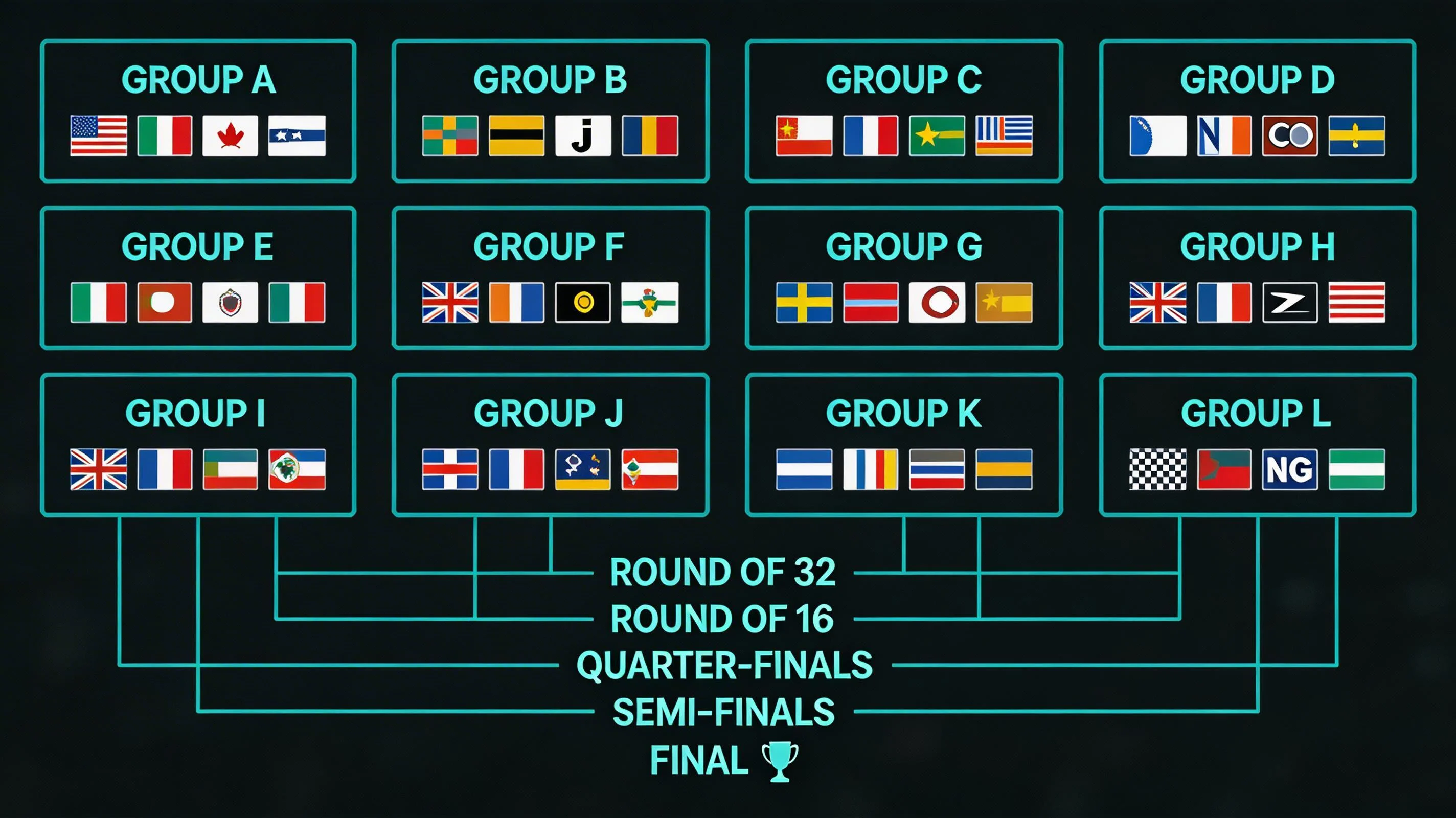
Group B presents the most compelling Canadian betting interest. Switzerland enters as group favourite at -110, reflecting their consistent European competition pedigree. Canada prices at +260, attractive for a host nation playing all three group matches on home soil (Toronto and Vancouver). Qatar at +550 and Bosnia and Herzegovina at +270 round out a group without a dominant favourite. The latter’s presence – after stunning Italy in qualification playoffs – adds chaos potential that group winner odds may underestimate.
Group C offers classic favourite versus dark horse dynamics. Brazil at -200 dominates pricing, with Morocco (+400) representing the obvious secondary play given their 2022 semifinal run. Scotland (+1200) and Haiti (+5000) complete the group without realistic winning expectations. The value question centers on Morocco: does +400 adequately price their demonstrated ability to compete with elite opponents, or has the market overcorrected based on a single tournament sample?
Group D features USA at -140 despite drawing Turkey, Paraguay, and Australia – all capable of springing upsets. Host nation advantage supports the American pricing, but three competitive opponents create path-to-failure scenarios where a single slip costs group position. Turkey at +350 offers intriguing value if their Euro 2024 performance translates to World Cup consistency.
Groups of death – where elite teams cluster and advancement becomes brutal – shift value toward third-place finishes under the new format. Eight third-place teams advance to the Round of 32, meaning survival rather than dominance becomes the optimal strategic frame. Group F (Netherlands, Japan, Sweden, Tunisia) prices Netherlands at -125 and Japan at +250, but the real value may exist in backing both to advance (+120 combined) rather than picking a group winner outright.
Group winner betting rewards early action. Odds adjust throughout the tournament based on match results, injury news, and public perception shifts. Locking in pre-tournament prices on undervalued group winners captures value before information becomes widely distributed. The 24-48 hours following the draw announcement typically offer peak inefficiency as bookmakers rush to post lines before fully modeling group dynamics.
Golden Boot Odds
The Golden Boot market rewards goals, nothing else – and that singular focus creates pricing inefficiencies invisible in team-based markets. A striker scoring six goals in group stage blowouts and getting eliminated in the Round of 16 beats a finalist striker who scores four crucial knockout goals. This mechanical quirk shapes intelligent Golden Boot betting.
Kylian Mbappe enters as clear favourite at +350 to +400 across most books. The French striker’s combination of elite finishing, penalty-taking duties, and likely deep tournament run creates the profile bookmakers view as optimal for top scorer honours. Mbappe scored eight goals across the 2018 and 2022 World Cups, demonstrating consistency at the highest level that justifies his premium pricing.
Harry Kane follows at +600 to +700. England’s captain has led European leagues in scoring multiple times but has yet to replicate that domestic dominance at major international tournaments. His 2022 World Cup produced two goals in five matches – solid but below elite striker expectations. If England reaches the final, Kane could easily top six goals. If they exit in the quarters against a defensive setup, four goals might be his ceiling.
Lionel Messi at +1000 to +1200 represents narrative more than probability. At 38, Messi’s goal-scoring burden has shifted to teammates like Julian Alvarez and Lautaro Martinez. His 2022 Golden Boot (7 goals, 3 assists) came in peak Messi conditions that may not replicate four years later. Betting Messi requires faith that declining physical tools will be offset by tournament magic – possible, but not where sharp money concentrates.
Value exists further down the board. Jonathan David at +3000 offers Canadian interest given Canada’s likely emphasis on attack during home tournament matches, though his team’s expected knockout exit limits ceiling. Vinicius Jr. at +1500 presents Brazilian flair with questions about whether he receives sufficient chances in a team that distributes attacking responsibility broadly. Victor Osimhen at +2000 (if Nigeria qualifies) profiles as the classic high-variance Golden Boot play – excellent goals-per-minute ratio, uncertain team trajectory.
Path analysis determines Golden Boot probability more than raw talent. A striker on a team expected to reach the semifinals plays 6-7 matches, while a group stage exit limits exposure to 3 matches maximum. Teams expected to dominate weak groups (Brazil in Group C, Germany in Group E) put their strikers in blowout scenarios where hat tricks become possible. The Golden Boot rarely goes to the best individual player; it goes to the best player on a team that wins big and advances far.
Golden Glove Odds
Goalkeeper awards follow a different logic than outfield honours. The Golden Glove (best goalkeeper) correlates almost perfectly with tournament success – finalists’ goalkeepers win the vast majority of these awards because they play the most matches under the highest stakes. This creates a derivative market where betting Golden Glove essentially means betting tournament winner with a goalkeeper variable attached.
Thibaut Courtois prices at +400 to +450 for Belgium, representing a rare case where individual quality may exceed team trajectory. Courtois is widely considered the world’s best goalkeeper, but Belgium’s aging squad and tactical questions limit their realistic tournament ceiling. Betting Courtois at +400 requires Belgium reaching at least the semifinals – a path that seems less plausible each tournament cycle.
Emiliano Martinez at +500 to +600 offers the defending champion’s goalkeeper with proven World Cup pedigree. His 2022 penalty heroics and aggressive psychological gamesmanship made him a tournament icon. If Argentina reaches another final, Martinez becomes an overwhelming favourite based on cumulative performances. The question is whether Argentina navigates an expanded bracket successfully.
Mike Maignan at +700 represents France’s best path to a goalkeeper award. The AC Milan keeper has supplanted Hugo Lloris as France’s undisputed number one, bringing shot-stopping excellence and distribution quality that suits Didier Deschamps’ tactical approach. France’s deep runs correlate with exceptional goalkeeping – Lloris in 2018, Lloris (despite controversy) in 2022.
Alisson at +900 for Brazil and Jordan Pickford at +900 for England round out the realistic contenders. Both keepers provide solid rather than spectacular profiles, meaning their Golden Glove odds essentially track their teams’ tournament winner probabilities. Betting these prices only makes sense if you believe their team will reach the final and outperform current odds – a correlated bet structure that compounds risk rather than diversifying it.
Best Young Player Odds
The FIFA Best Young Player award goes to the outstanding player aged 21 or under at the tournament’s start. Eligibility is strictly age-based, meaning some tournaments feature stacked young player fields while others have limited options. The 2026 field includes several generational talents, making this market unusually competitive.
Lamine Yamal enters as prohibitive favourite at +150 to +200. The Spanish winger – born October 2007, meaning he turns 18 just months before the World Cup begins – already performed at Euro 2024 as Spain’s youngest ever tournament player. His combination of technical brilliance, tactical maturity, and likely deep Spanish run makes him the obvious play. The question is whether +150 offers any value on such a consensus pick.
Jude Bellingham at +350 to +400 creates debate. He turns 23 in June 2026, potentially making him ineligible depending on exact cutoff dates. If eligible, Bellingham’s central role in England’s attack positions him as Yamal’s primary challenger. Verify eligibility dates before betting – nothing wastes money faster than backing an ineligible player.
Florian Wirtz at +500 represents Germany’s answer to the young superstar question. The Bayer Leverkusen playmaker has transformed into a world-class talent, and Germany’s expected deep bracket run provides platform for award-worthy performances. Wirtz combines goals, assists, and creative metrics that satisfy award voters seeking complete attacking contributions.
Endrick at +700 offers Brazilian upside. The Real Madrid teenager has immense potential but may not receive consistent minutes in a Brazil squad featuring established attackers. Young player awards require actual playing time – bench presence does not generate highlight reels. If Endrick becomes Brazil’s primary striker due to injury or form fluctuations, his odds represent significant value. If he plays 30 minutes per match, +700 is unplayable.
Understanding Odds Movement
Odds tell stories over time, not just in snapshots. The price you see today reflects thousands of betting decisions, injury reports, friendly results, and bookmaker risk management adjustments accumulated since markets opened. Reading odds movement – understanding why prices shift and what those shifts signal – separates informed betting from blind gambling.
Steam moves indicate sharp money. When Argentina’s odds shift from +450 to +400 across multiple books within hours, professional bettors have likely identified value and are loading positions. Sharp money moves lines; recreational money follows lines. If you catch a steam move early, the original price represented genuine value. If you bet after the move, you are buying at inflated prices created by others’ analysis.
News-driven movement behaves predictably. When a starting goalkeeper suffers a tournament-ending injury, his team’s odds lengthen within minutes. This immediate reaction often overcorrects – markets panic, then stabilize at more reasonable levels within 24-48 hours. Patient bettors wait for overcorrection to subside before acting on news, while reactive bettors often lock in the worst prices during peak panic.
The 2026 World Cup’s timeline creates multiple movement windows. Qualification playoffs (concluding March 31, 2026) finalize the 48-team field and trigger significant repricing. The official draw (December 2025) reshuffled group compositions and bracket paths, causing immediate odds adjustments. Pre-tournament friendlies in May and June 2026 provide final squad fitness information. Each window offers opportunity if you anticipate how news will translate to price changes.
Reverse line movement signals professional disagreement with public perception. If 75% of bets back Brazil but Brazil’s odds lengthen rather than shorten, bookmakers are either receiving very large bets on the other side or adjusting their own models against public opinion. Reverse line movement does not guarantee the contrarian side wins, but it indicates where sharp and square money diverge.
Finding Value in World Cup Markets
Value exists when a team’s true probability exceeds the probability implied by their odds. Sounds simple. In practice, identifying true probability requires analytical frameworks, historical reference points, and honest assessment of your own knowledge limitations. The market represents aggregated opinion from millions of bettors and sophisticated bookmaker models – beating it consistently requires either superior information or superior analytical application of public information.
Start with model-free probability anchoring. Ask yourself: would I accept a coin flip between Team A winning the World Cup and some monetary outcome? If Argentina at +450 implies 18% probability, would you take 18% chance of winning $450 against 82% chance of losing $100? Your instinctive answer reveals your internal probability estimate. If you would happily take the bet, your estimate exceeds 18% and value may exist. If you would refuse, the odds are fairly priced or worse.
Historical base rates provide structural guidance. Sixteen World Cups since 1958 have produced 16 different winners (Brazil won 3, Germany 3, Italy 2, Argentina 2, France 2, Uruguay 1, England 1, Spain 1). The most frequent winners – European and South American football powers – have won 15 of 16 tournaments. The single exception, 1998 France winning at home, reinforces rather than contradicts European/South American dominance. Longshot value rarely exists at the tournament winner level because historical base rates confirm elite team dominance.
Where does value concentrate? In subsidiary markets where recreational money distorts pricing. Group winner odds often misprice when casual bettors back famous names over tactically superior opponents. “To Qualify from Group” markets occasionally underestimate strong teams in difficult groups because the market focuses on group winners rather than advancement. Golden Boot odds for strikers on teams expected to dominate weak groups sometimes offer value because goal-scoring opportunity – not just ability – drives top scorer outcomes.
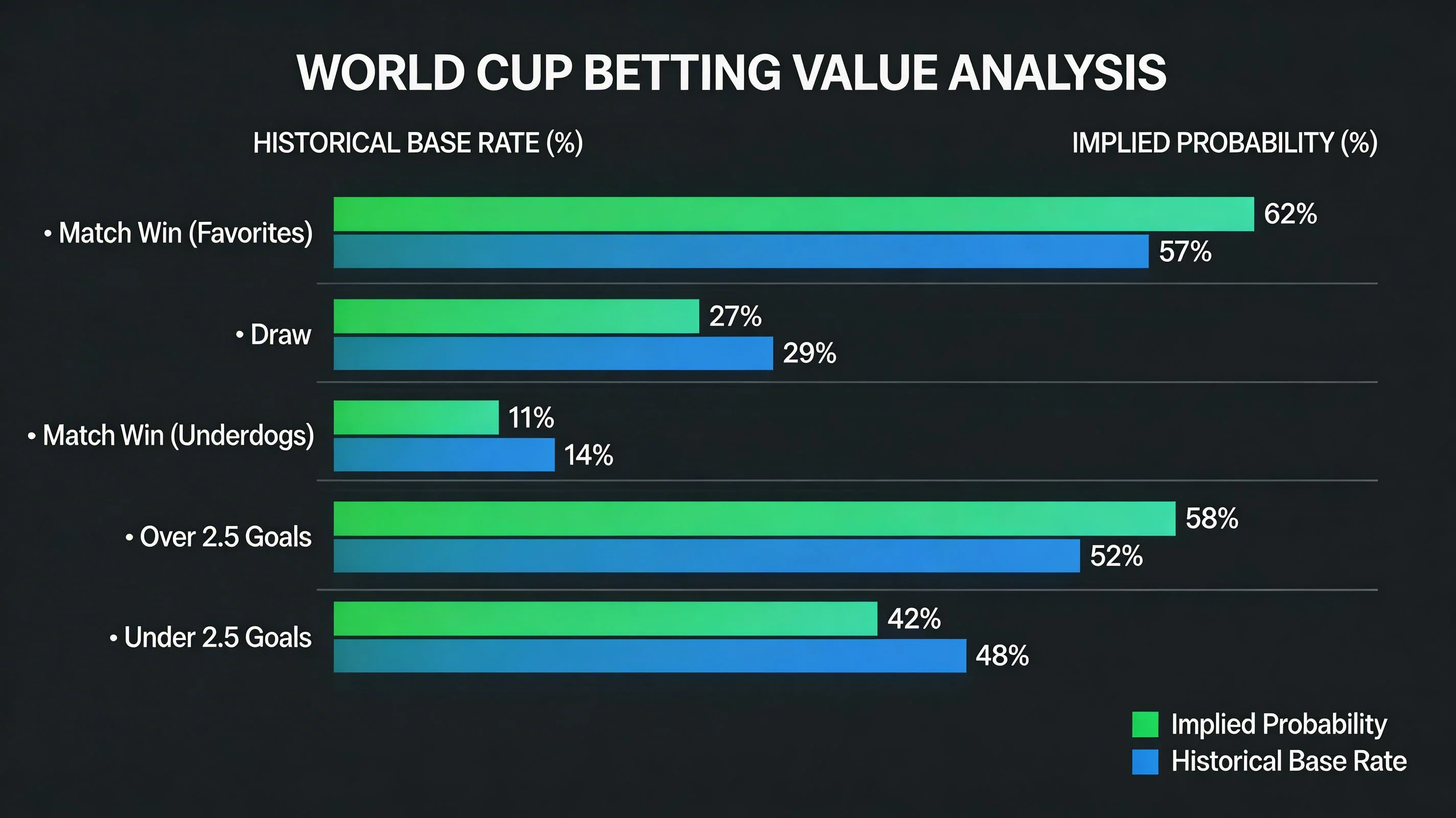
Sample size considerations affect confidence levels. A team’s World Cup odds reflect FIFA ranking, recent tournament performance, and squad quality assessment – but most national teams play only 10-15 meaningful matches per year. Drawing conclusions from such limited samples invites overfitting. Croatia’s back-to-back semifinal appearances (2018, 2022) may represent their true level or may represent positive variance that will regress. Uncertainty should make you more conservative, not more aggressive.
Where to Find the Best Odds
A 10% difference in odds means a 10% difference in potential profit. Over dozens of World Cup bets, those differences compound into meaningful money. Comparing odds across platforms is not optional for serious bettors – it is fundamental practice that separates positive expected value activity from unnecessary margin donation to bookmakers.
Ontario’s regulated market provides the most competitive Canadian landscape. Licensed operators including bet365, FanDuel, BetMGM, theScore Bet, and others compete for customers through promotional offers and pricing. Competition narrows margins, creating more efficient prices than monopoly markets where a single provider sets all lines. Ontario bettors should maintain accounts at multiple books and place each bet at the platform offering best price.
Provincial lottery platforms – BCLC’s PlayNow, Loto-Quebec’s Mise-o-jeu+, Atlantic Lottery’s Proline Stadium – offer convenience and regulatory security but typically provide worse odds than competitive private markets. A 5-10% margin disadvantage on each bet might feel negligible, but over a 50-bet World Cup campaign, that margin difference represents significant opportunity cost. Where legal options exist, comparing provincial platforms against licensed private alternatives reveals consistent pricing gaps.
Timing affects odds comparison value. Books post World Cup futures months before the tournament, with early lines often exhibiting wider variance than mature markets. Shopping for best odds in January 2026 yields larger discrepancies than shopping in June 2026 when all books have refined their models. Early betting at advantageous prices locks in value that may not exist as markets converge toward efficient consensus.
Promotional offers create effective odds enhancement. A new account bonus or enhanced odds promotion can transform a marginally negative expected value bet into a positive one. Read promotional terms carefully – wagering requirements, bet size limitations, and outcome restrictions affect actual value. A “+500 enhanced to +600” promotion that limits stakes to $10 provides less total value than a standard +500 with unlimited stakes and a 100% deposit match.
Current Market Assessment
The World Cup 2026 odds landscape reveals a market that has priced elite European and South American teams efficiently while potentially undervaluing host nation advantages and overvaluing name recognition among second-tier powers. Argentina, France, England, and Brazil command roughly 70% of implied probability among the four of them – a concentration that historical base rates support but that may overcorrect for the chaos inherent in expanded tournament formats.
Value opportunities exist at the margins. Host nations USA, Mexico, and Canada benefit from home conditions that odds may underweight, particularly in early tournament rounds where travel and adjustment factors affect visiting opponents. Dark horse teams like Morocco, Japan, and Colombia possess the tactical discipline to upset elite opponents in knockout rounds while pricing at significant discounts to their demonstrated capability. Golden Boot markets appear to overprice Mbappe consensus while underpricing strikers on teams expected to dominate weak groups.
Between now and June 11, 2026, odds will shift based on injury news, friendly results, and market action. The current prices represent baseline expectations that will adjust as new information emerges. Monitoring movement, understanding what drives price changes, and acting decisively when value appears – these habits distinguish profitable World Cup bettors from those who bet and hope. The framework exists. Application determines results.
