

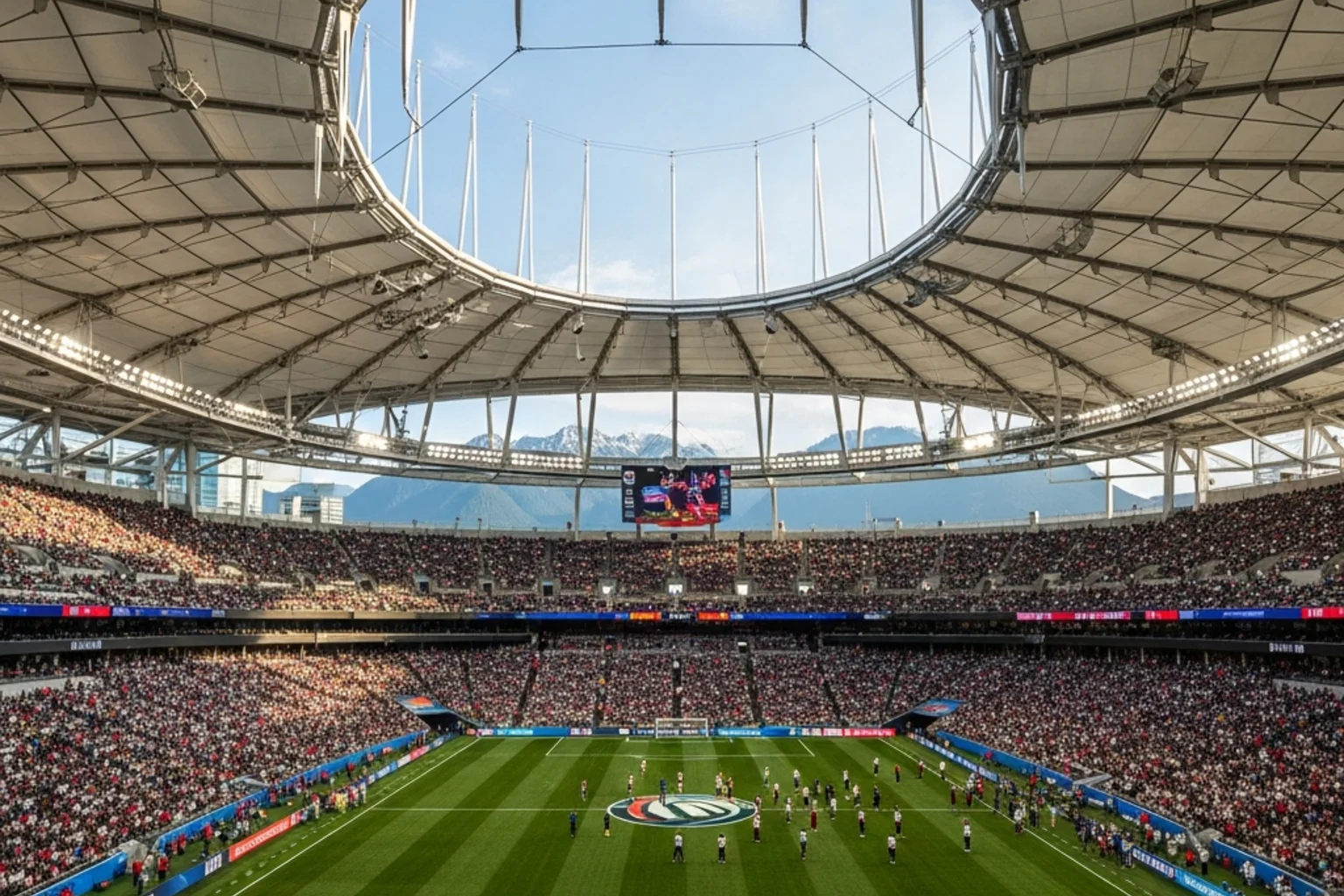
When the rain started falling at BC Place during the 2015 FIFA Women’s World Cup final, nobody inside noticed. The retractable roof had closed seamlessly hours earlier, creating perfect playing conditions while a Pacific Northwest downpour battered everything outside. That technological capability – the ability to guarantee weather-controlled football regardless of Vancouver’s famously unpredictable climate – makes BC Place the jewel of Canada’s World Cup 2026 hosting contribution.
Vancouver’s role in the tournament extends beyond a single venue. The city represents Canada’s Pacific gateway, a global destination whose Asian diaspora communities will transform matches involving nations like Japan, South Korea, and Iran into genuine home fixtures. BC Place provides the infrastructure; Vancouver’s multicultural identity provides the atmosphere.
BC Place Overview
BC Place Stadium anchors Vancouver’s downtown False Creek waterfront, surrounded by the residential towers of Yaletown and the entertainment district that has emerged since the stadium’s 1983 opening. Unlike suburban venues requiring highway access and massive parking infrastructure, BC Place integrates into the urban fabric of a walkable downtown core. Supporters can arrive by SkyTrain, bus, or simply walking from nearby hotels – a rarity among North American sports facilities of this scale.
The original air-supported dome roof that characterized BC Place for its first 28 years collapsed under snow weight in 2007, forcing a reconstruction that ultimately proved fortunate. The replacement retractable roof, completed in 2011 at a cost exceeding $500 million CAD, represents state-of-the-art stadium technology. The cable-supported structure opens in approximately 20 minutes, allowing venue operators to choose between covered protection and open-air conditions based on weather forecasts and event requirements.
The roof’s engineering provides more than rain protection. When closed, BC Place maintains temperature-controlled conditions that protect players from Pacific Northwest chill during evening matches. When open, the stadium benefits from spectacular mountain views that no other World Cup venue can match – the North Shore peaks visible beyond the open end create backdrops that FIFA’s broadcast teams will showcase to global audiences.
BC Place serves as home to the Vancouver Whitecaps of Major League Soccer and the BC Lions of the Canadian Football League. The dual tenancy requires field configuration flexibility that the artificial playing surface enables – conversion between football codes happens within hours rather than the days required for natural grass transitions. For World Cup 2026, FIFA has mandated installation of natural grass over the existing turf, transforming the playing surface while maintaining the venue’s other operational capabilities.
Capacity for World Cup matches reaches approximately 54,000, making BC Place modestly larger than Toronto’s BMO Field while remaining smaller than the American mega-stadiums that host knockout rounds. This mid-tier capacity creates intimate atmosphere where supporter intensity translates directly to pitch-side pressure – exactly the environment that Canada’s home matches demand.
Retractable Roof Advantage
Vancouver’s climate makes the retractable roof more than architectural vanity – it represents functional necessity that directly affects match outcomes. June in Vancouver averages 17-22 degrees Celsius, comfortable temperatures that can turn chilly when marine cloud layers roll in from the Pacific. The roof provides insurance against conditions that would disadvantage teams unprepared for Pacific Northwest weather patterns.
For betting purposes, the roof creates predictable playing conditions regardless of forecast. Unlike open-air venues where rain, wind, and temperature fluctuations inject randomness into match outcomes, BC Place matches occur under controlled circumstances. Technical teams that rely on precise passing patterns benefit from this predictability; direct teams that would welcome chaotic conditions lose a potential equalizer.
The roof also affects goalkeeper performance in ways casual observers miss. Natural light conditions shift dramatically in covered versus open configurations – shadows, glare, and depth perception all change based on roof position. Keepers preparing for BC Place matches must train for both scenarios, adding preparation complexity that can create advantages for teams with more experienced coaching staffs.
Sound amplification differs between roof configurations as well. When closed, BC Place traps crowd noise within the bowl, creating intensity levels that approach indoor arena atmospheres despite the stadium’s outdoor structural heritage. This acoustic environment favours passionate supporters over larger but less engaged crowds – 45,000 committed fans in a closed-roof BC Place can generate noise exceeding 70,000 in an open stadium with casual attendance.
The operational flexibility extends beyond single-match considerations. Tournament organizers can adjust roof status between matches based on conditions, though FIFA guidelines require advance notice to participating teams. These decisions become part of the strategic landscape – teams with strong weather-related tactical preferences may find themselves playing under conditions that neutralize their advantages.
World Cup 2026 Matches at BC Place
BC Place hosts Canada’s second and third group stage matches, following the June 12 opener at BMO Field. The venue assignment gives Canadian supporters two opportunities to see their team on the Pacific coast, while providing visiting teams the unique experience of playing in one of North America’s most distinctive stadiums.
Canada versus Qatar on June 18 represents a compelling matchup between the 2022 World Cup hosts and the 2026 hosts. Qatar’s experience from their home tournament provides useful data points – they know what it means to carry host nation expectations, and they know how difficult it is to advance from the group stage under that pressure. The 6:00 PM PT kickoff creates primetime viewing for Pacific Coast audiences while accommodating evening broadcasts in Eastern Canada.
The decisive group match against Switzerland on June 24 could determine whether Canada advances to the knockout rounds. Switzerland enters as Group B favourites based on FIFA rankings, but facing Canada in Vancouver – where 54,000 supporters will create atmosphere the Swiss have never experienced in competitive fixtures – changes the calculus. The 3:00 PM PT kickoff means 6:00 PM ET start time, optimal for national viewership across Canada’s time zones.
Beyond Canada’s matches, BC Place hosts additional group stage fixtures that will draw from Vancouver’s diverse communities. Matches involving Asian teams particularly benefit from the Pacific Rim location – flights from Tokyo, Seoul, and Beijing arrive more quickly in Vancouver than any other World Cup venue, and the city’s Asian populations create instant supporter bases for multiple participating nations.
The natural grass installation required for World Cup standards will transform BC Place’s playing surface from the artificial turf that regular tenants use. This temporary conversion requires careful planning – the natural grass must establish roots while remaining playable through the tournament period, then yield to artificial turf reinstallation for subsequent MLS and CFL seasons. Grounds crews have studied successful conversions at other temporary-turf venues to ensure quality meets FIFA requirements.
Canada’s Vancouver Matches
The June 18 fixture against Qatar carries distinct narrative weight. Qatar’s 2022 World Cup was marked by criticism over human rights concerns and the surreal experience of hosting a winter tournament that disrupted European league calendars. Playing Canada just four years later – now as guests rather than hosts – represents a fascinating role reversal that extends beyond the 90 minutes of match play.
Qatar’s squad presents tactical challenges despite their status as Group B underdogs. Their Asian Cup 2023 victory demonstrated genuine quality when playing within their capabilities, and their compact defensive structure frustrated better teams throughout that tournament. Canada will need patience against opponents comfortable sitting deep and counter-attacking – the kind of match where home crowd pressure can become counterproductive if desperation creeps into Canadian play.
The Switzerland match on June 24 likely determines group advancement for both teams. The Swiss bring European pedigree and knockout-round experience from multiple recent tournaments, making them the most dangerous Group B opponent. However, playing in Vancouver against a Canada team already through to the Round of 32 (assuming a Bosnia victory and Qatar result don’t conspire against them) changes the dynamic. The pressure shifts to Switzerland if Canada enters the match having already secured advancement.
Vancouver’s atmosphere will differ from Toronto’s opener in character if not intensity. The Pacific Northwest football culture, built around Whitecaps supporters and nurtured through women’s national team success, has its own personality distinct from Ontario’s growing football scene. Supporters traveling from Toronto for the Vancouver matches will find a different flavor of Canadian football passion – perhaps quieter in volume but no less committed in substance.
The betting dynamics for Canada’s BC Place matches depend heavily on the Bosnia result. A Canada victory in Toronto creates house money for the Vancouver fixtures – the team can play freely knowing they’ve already achieved the minimum acceptable World Cup result. A Toronto loss creates desperate urgency that could either inspire heroics or compound pressure. Monitor Canada’s opening result carefully before committing to Vancouver match wagers.
Location and Access
BC Place occupies perhaps the most accessible location of any World Cup 2026 venue. The Stadium-Chinatown SkyTrain station sits directly adjacent to the stadium, with service from both the Expo and Millennium lines providing connectivity throughout Metro Vancouver. Supporters arriving at Vancouver International Airport can reach BC Place via the Canada Line in approximately 30 minutes – no rental cars or shuttle buses required.
The False Creek waterfront surrounding BC Place provides entertainment options that suburban stadiums cannot match. The seawall walking path connects the venue to Granville Island, Science World, and the downtown shopping district, creating a continuous pedestrian corridor that encourages exploration before and after matches. Yaletown’s restaurants and bars, walking distance from the stadium, will serve as gathering points for supporters of all nations.
Hotel availability in downtown Vancouver exceeds most North American cities of comparable size. The convention and cruise tourism industries have created lodging capacity that absorbs major events without the shortage problems that smaller markets face. World Cup visitors will find options from budget hostels to luxury waterfront properties, all within walking or transit distance of BC Place.
The Canadian national team’s World Cup campaign reaches its peak intensity at BC Place, where the group stage concludes and knockout qualification is determined. Vancouver’s role as Canada’s final group stage venue means the decisive moments of Canada’s World Cup happen here – whatever joy or heartbreak awaits, BC Place will witness it.
Vancouver as World Cup Host
Vancouver has hosted major international events successfully for decades, from Expo 86 through the 2010 Winter Olympics and beyond. The city’s infrastructure, hospitality industry, and event management expertise position it among North America’s most capable host cities for gatherings of global significance.
The Pacific Rim location creates unique supporter dynamics. Vancouver’s Asian communities – Chinese, Korean, Japanese, Filipino, Vietnamese, and South Asian populations combined – exceed half the metropolitan population. Matches involving Asian nations become de facto home fixtures, with supporters who understand football culture from their countries of origin creating atmospheres that European or South American visitors find unexpectedly intense.
British Columbia’s decision to abandon seasonal time changes means Vancouver operates on Pacific Time year-round starting March 2026. This simplifies scheduling calculations – no need to track whether daylight saving has shifted kickoff times relative to other venues. The consistent UTC-7 offset also creates favourable broadcast windows for Asian audiences, potentially increasing global viewership for BC Place matches.
June weather in Vancouver averages 17-22 degrees Celsius with lower humidity than American Gulf Coast venues. The mountains create occasional afternoon cloud formations that can bring brief rain, but conditions generally favour outdoor activity. The long summer daylight – sunset after 9:00 PM in late June – extends supporter activities well into evening, creating festival atmospheres throughout the downtown core.
Vancouver’s progressive cultural identity shapes the supporter experience in ways that differentiate it from other host cities. The city’s emphasis on sustainability, inclusion, and community engagement will influence how World Cup events are organized and how visitors experience Canadian hospitality. This represents an opportunity to showcase Canadian values on the global stage – a World Cup that feels distinctly Canadian in character even while following FIFA’s universal protocols.
